(Text and photos: author)
Twice in some 30 years my aviation trips really hung by a thread. And each time, of course, it was a very special trip.
My visit to the Nigerian Air Force Expo in Kaduna in 2010 first threatened to fail because of a missing yellow fever vaccination, which I only managed to get at the last moment during a business trip. Then the death of the president delayed the issue of the visa, so three days before departure I drove to Berlin in person to dig my visa out of a pile of unsent mail. And then a volcano called "Eyjafjallajökull" overloaded all booking platforms, so that I only finally held my ticket in my hands on the eve of my trip, eight hours before the planned departure. On the trip to my only air-to-air shoot with MiG-21s in Bulgaria in 2015, all the obstacles – a closed motorway, a completely overloaded diversion and full car parks – only arose on the way there, one right after the other, and meant that I could only reach my aircraft by sprinting across the apron. In both cases the stress was enormous, and yet neither compares with what awaited me on my trip to the Indian MiG-21 farewell in Chandigarh.
India is not an easy country to travel in anyway if you are planning more than a package tour. My attempts to organise a visit to an Indian MiG-21 base had always failed for some 25 years – a visit to Aero India 2003 in Bangalore was my first and only contact with the IAF's MiG-21s. This was often due to refusals from the Indian side, but mostly simply because my requests went unanswered. As I have now learned, it was probably also because I gave up too early.
This time everything was to be different. When at the end of July 2025 the Indian press reported that the long-planned farewell to the MiG-21 would take place in Chandigarh in September, it was clear: I had to be there. There would be no other chance, and besides, no MiG-21s were flying in Europe any more, so there were no alternative destinations left. Wanting to see flying MiG-21s now meant leaving Europe. All other planned or at least contemplated activities had to take a back seat. While the visit to Radom had already fallen victim to the fatal crash of the F-16, all the other dates – whether the airshows at Sanicole, Ostrava or Malta, the Su-22 farewell at Mirosławiec, the parade and fair in Belgrade or the hitherto unattainable event at Changchun in China – suddenly no longer mattered.
As early as the previous year I had again requested a base visit in parallel through the German embassy in India and the Indian military attaché in Berlin, but had again been refused. In view of the "predicament" that had now arisen, I contacted both offices again. While I was turned down by the military attaché staff in New Delhi (even though the German military attaché in Zagreb, Lieutenant Colonel Weber, who had already made my farewell visit to Zagreb-Pleso possible, had expressly put in a word for me with his colleagues), the Indian Defence Advisor, as the official title goes, Brigadier AP Singh, was willing to support me again this time. As will be seen, his help was to prove decisive.
First, however, I had decided to make enquiries through all channels so as not to fail in some government office at the end. The only problem was that the websites of the Indian Air Force and the Indian Ministry of Defence would not open on any of my PCs, so I could not find the relevant contact addresses there. Fortunately, some could be found in search results, and earlier correspondence also provided possible contacts – the only question was whether this information was still current. In any case, at the beginning of August I sent numerous e-mails in all directions, with references and a detailed description of my background and intentions. The result: radio silence.
Time for the next stage: social media. On LinkedIn I searched for high-ranking current or former IAF officers, including a real Air Marshal and former Defence Advisor. And indeed, he and some of his colleagues were willing to support me, forwarded my request and followed it up. In the end, however, it became clear again and again that the IAF press office was the linchpin. I had written there but – once again – received no answer.
I was not quite at my wits' end yet, since thanks to numerous publications I also had many contacts with people outside the official structures, who in turn are well networked (and I immediately asked myself why I had not used these contacts earlier to set up my trips). Among those I approached was Tom Cooper, an expert on air warfare in the Middle East and currently also one of my series editors for the two volumes on the Chinese MiG-21 export versions just published by Helion & Company in Great Britain. And through his extensive network he provided the decisive information – the phone number of the IAF press officer, Wing Commander Jaideep Singh. And indeed, the request sent through this channel was answered immediately, including confirmation that my letter had been received.
From this moment on my memory becomes a little hazy, because the relevant record, my WhatsApp history of the last few months, fell victim to a change of device. Precisely the decisive dialogues are now missing. In any case, in the exchange with Wg Cdr Singh it became clear: a journalist visa was the prerequisite for participation.
Years ago I would have needed one to attend the media days of Aero India, but had failed to meet the requirements and had then somehow wangled my way through on site. This time that was not an option; the risk of final failure was simply too great. The first research on the journalist visa was sobering: unlike the e-visa, for journalists the application required a personal appearance at the company commissioned by the Indian embassy – at least 300 kilometres from where I live, and in the case of the nearest office in Berlin booked up two weeks in advance. And the date was getting ever closer. It had been postponed by a week from September 19 to 26 beforehand, but we were now at the beginning of September and there was much more to organise.
Even more problematic than the timing was the fact that a valid press card is one of the requirements for a journalist visa, which as a hobby author I of course do not have. Nevertheless, I booked an appointment with the visa service provider in Munich (where short-notice appointments were available) and paid the fees, only to realise that the undertaking was doomed to failure. Given the clear conditions and strict regulations in India, any missing requirement would be a knock-out criterion. At this point the Defence Advisor, who had previously signalled the refusal from New Delhi, came into play again. When I phoned him, he kindly agreed to find out how I could nevertheless obtain the necessary visa and promised to support me with the application. And indeed – a few hours later the news came from Berlin that I could get a journalist visa. But I would have to appear in person at the military attaché's office in Berlin and submit my documents. In the case of Nigeria I had driven to Berlin to collect the visa, so why should I not go there to apply for India? Ready to set off the next day, I replied to the e-mail saying that, once confirmed, I could be in Berlin around noon the next day. But the confirmation never came, and nobody could be reached by phone to clarify how to proceed. And that was to remain the case for the next few days.
To make matters worse, I would be in Munich on business up to and including Wednesday of the following week, with no possibility of getting to Berlin during that time. The next opportunity for this trip would be September 11, just over two weeks before the date and only a week and a half before the planned departure.
Every free minute of my business trip I tried to reach the Defence Advisor or his staff, without success. Only on September 10 did I finally get his assistant on the phone – the attaché was on an official trip – and that same evening the confirmation came that I could come to Berlin the next morning to apply for the visa. So back from Munich in the evening and straight to Berlin the next morning. The journey goes smoothly, as does the reception at the embassy. But when the attaché's assistant returns from the visa section after about half an hour, he is not holding the hoped-for visa but only my documents, and tells me that the application will take at least three working days. Frustrated, I set off home; after all, it is becoming less and less likely that my visa will be ready in time. My mood sinks further when a call on the following Monday reveals that the visa is still not ready. Now there is only one week left until the planned departure. And my mood hits rock bottom when I learn from India that, in addition to the visa, an NOC, a no objection certificate from the embassy, is required. I have never heard of it and therefore have no idea how to get one. On Tuesday, which is also my birthday, comes the relieving news: the visa is ready for collection. However, when asked, the staff member knows nothing about the NOC. So I call Brigadier AP Singh again, who assures me that if I come to Berlin tomorrow, this document too will be ready for collection on his desk.
The collection is again uneventful. After six hours of driving and half an hour at the embassy, I am really hopeful for the first time and immediately set about booking the flights and the hotel. Before leaving Berlin I had already sent photos of the visa and NOC to the press officer in Delhi. Immediately after returning I also send them by e-mail and receive an acknowledgement.
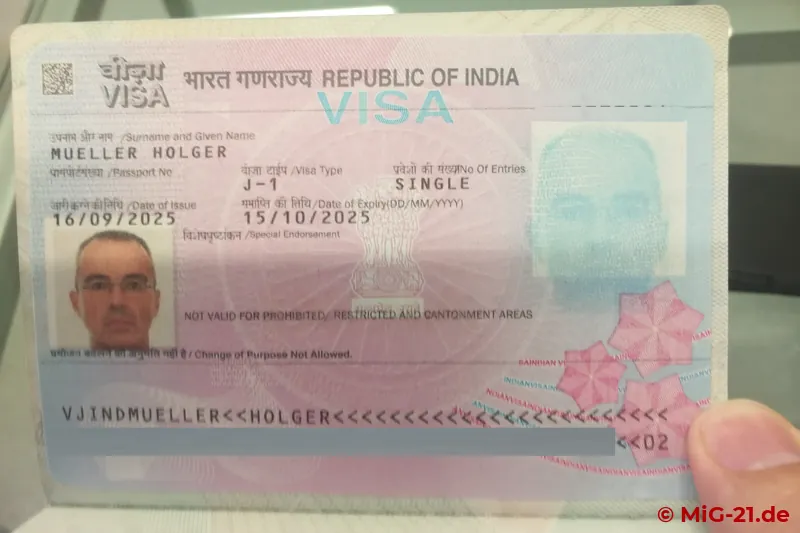
The weekend is filled with preparations, and on Monday I pack my things to drive to Frankfurt in the afternoon and fly to Delhi from there. I inform the IAF press officer that I am about to set off, and he replies that I should wait until clearance has been granted. Restlessly I keep looking at my phone, expecting a reply from Delhi. When it comes, I am stunned. There is a problem with my visa. It says "Not valid for prohibited / restricted and cantonment areas", and that would prevent my access to the airfield. I had seen the text, but had not given it any thought; after all, the visa had been issued precisely for a specific purpose. My mood swings between anger and despair. I send a message to Brigadier Singh, and he replies immediately that he will take care of it. He also calls India and spends the whole morning trying to sort things out, unfortunately in vain. I would need a new visa, which I could get immediately, but would have to come to Berlin again before travelling to Frankfurt. Even if I wanted to, that would be impossible in terms of time. The flight cannot be rebooked, and besides, I would arrive too late to see the rehearsal on Wednesday. For, as I have meanwhile learned from the Indian press, a dress rehearsal is held two days before the actual event. And of course I want to be there.
To my question to India as to what I could do to make it work after all, the laconic answer comes: nothing. I could only wait for the clearance – which, however, means there is still hope. So I set off, in pouring rain and with anxious anticipation. Near Eisenach the relieving news arrives: "You are cleared". At the same moment the sky clears and the sun shines through the clouds over the Wartburg. Now nothing can really go wrong.
And indeed, the drive to Frankfurt is uneventful and quick. The reserved parking space is quickly found, and a few minutes later the shuttle bus takes me to the terminal. Check-in and security are done faster than I have ever experienced in Frankfurt. This makes the wait longer, but the stress much lower.
The stress level rises again when I see an Air India Boeing 787 docking at the gate; after all, the disastrous crash of such an aircraft at Ahmedabad was only a good three months ago. But since it made it here from Delhi, it will be fine. It is fine. The flight is quite relaxed, not least thanks to unexpected legroom.
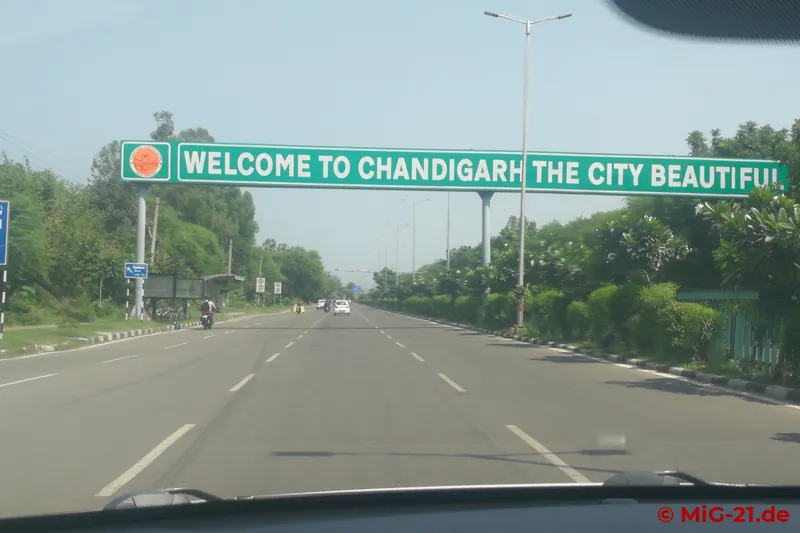
Passport control, baggage collection and checking in again drag on, but here too there is enough time before take-off for the 230-kilometre hop to Chandigarh. Why I fly this ridiculously short distance and do not choose a comparatively cheap taxi: because I know Indian road traffic from two previous trips and want to minimise the risk. My fellow passengers obviously feel the same; at any rate the aircraft is well filled, from business class to economy.
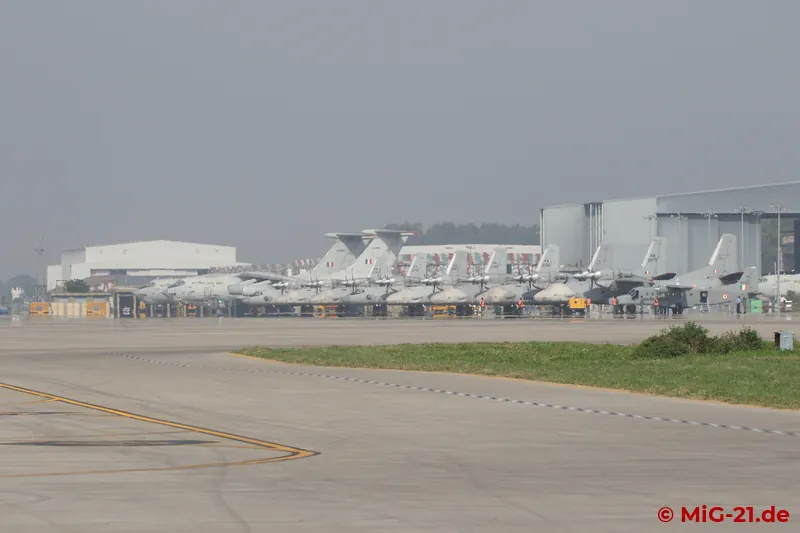
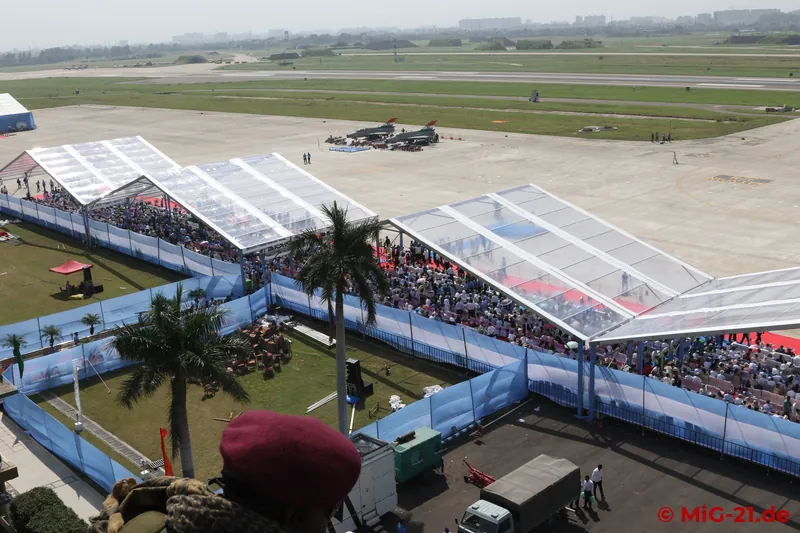
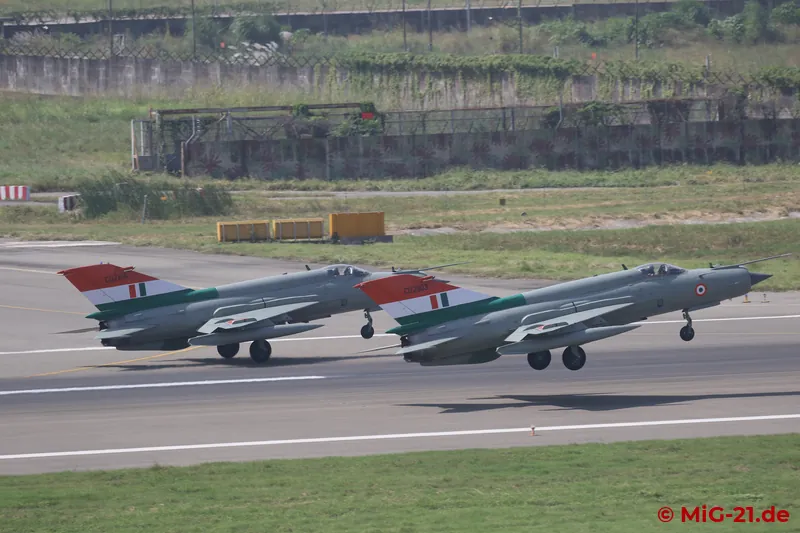
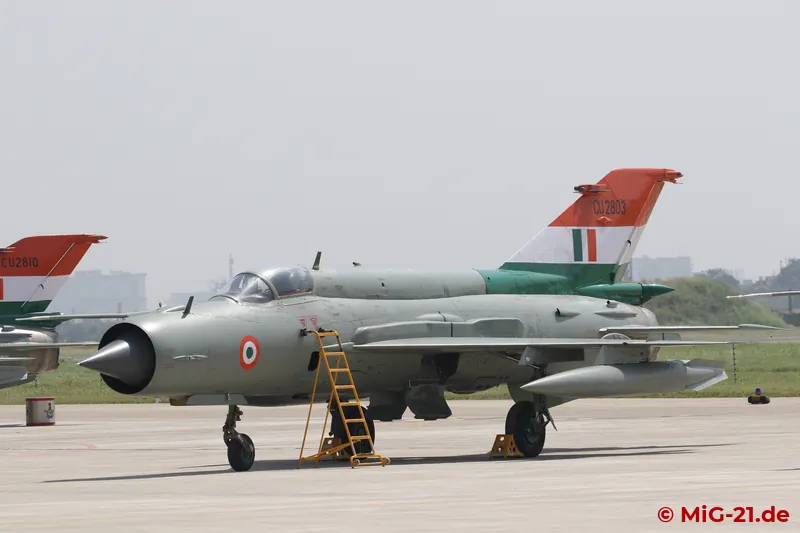
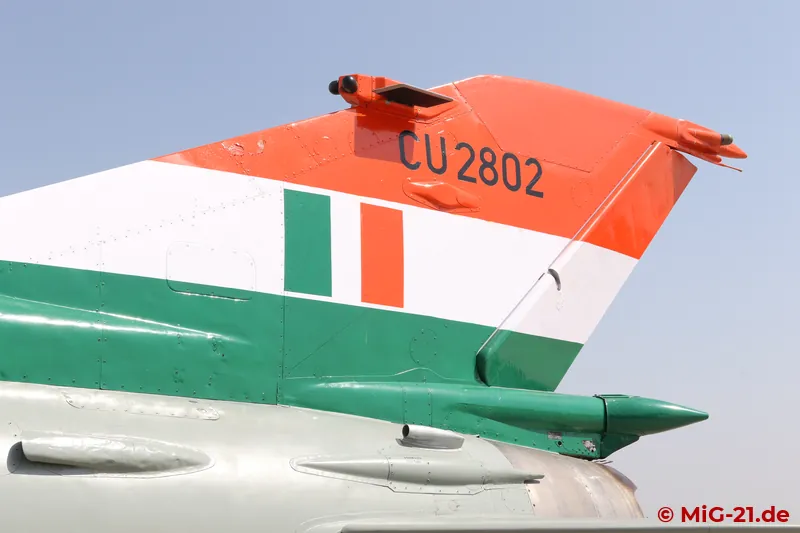
On the approach to Chandigarh I look out for the two MiG-21s with the Indian flag covering the whole fin, which have meanwhile been ferried there – in vain. I see the grandstands for the event and the transport aircraft and helicopters based at Chandigarh – C-17, Il-76, Chinook – but no MiG. The mystery was to be solved the next day. The MiGs – ten instead of the presumed two – are in the shelter area on the other side of the runway.
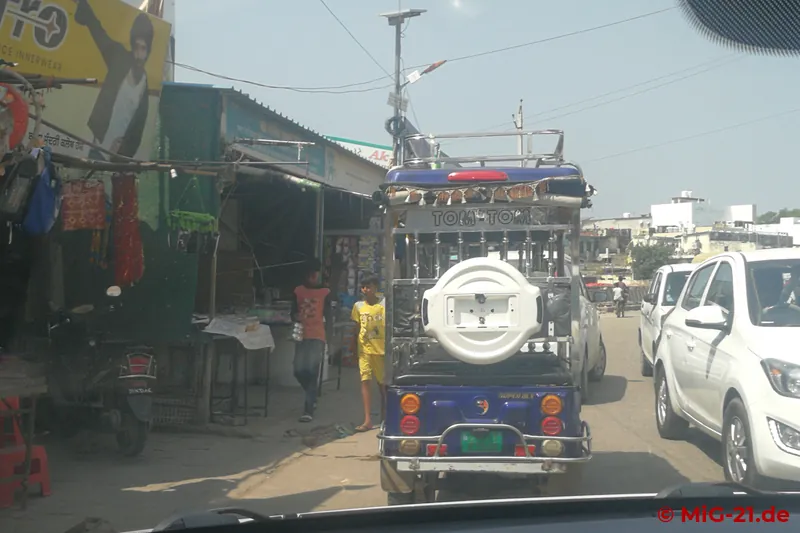
Leaving the aircraft – we get out via airstairs and walk across the apron – the heat hits me like a hammer. 35°C and extreme humidity – a shock after the rather cool temperatures at home. The luggage has arrived (largely) safely, a taxi is quickly found, and the drive to the hotel through the everyday traffic jam is bearable thanks to the air conditioning in the small Korean car. The hotel is acceptable, the evening meal delicious and opulent (and so it will continue for the next four days ☺). But none of that is as important as the question of whether I will manage to see something of the dress rehearsal the next day and ideally photograph it (of course I would have liked to attend the rehearsal officially and take the opportunity to experience the sequence without protocol and therefore certainly with more freedom of movement, but as I had not known about the rehearsal beforehand, I had not applied to attend, and my subsequent request was turned down).
The next day I set off so early that I am at the airport two hours before the announced start, to explore the terrain and look for possible photo positions. The start is not very promising. I am refused entry to the terminal because I do not have a valid ticket. At the same time my passport is demanded, and as I take it out of the rucksack, the zip gives up the ghost. From then on I can no longer close the rucksack properly and my camera sticks out of the top.
At least I can walk along outside the building on the departures level, and there I see them – seven MiG-21s with gleaming red-white-green fins. Actually the departures level would be the ideal place to take pictures. But there is no chance of doing so unobserved. Uniformed security personnel everywhere, already staring at me curiously, as there are hardly any foreigners about apart from me. Added to that are masses of airport employees, who obviously also have plenty of time to spend outside their offices, and of course the passengers constantly streaming into the building.
Beforehand I had looked at possible spots in the surrounding area, not least on the website of Scramble, the Dutch aviation magazine, which has a detailed guide to Chandigarh. But the Dutch colleagues had obviously rented a car, which I had ruled out from the start because of the completely chaotic Indian traffic. In any case, the spots described are completely unreachable because of the heat and the fact that pedestrians somehow do not feature in Indian traffic. So only one place nearby remains. On the arrivals level, however, I cannot take a step without somehow being approached about whether I need a taxi or what I want here. So first I have to put some distance between me and them and circle the arrivals and departures area and the car parks. For lack of footpaths and of consideration by drivers, this too is arduous and not entirely without danger. Only one area next to the departure ramp comes into question as a possible photo spot at all. Here the view is reasonably clear and no uniforms are in sight, at least not in the immediate vicinity. But only about 100 metres further on, a military reception committee has lined up under flags, obviously waiting for high-ranking visitors. In addition there is a building site here, and construction workers sit in their vehicles eyeing me suspiciously. So I walk on, away from the airport, following a road that leads between buildings. I have not gone a hundred metres when a motorcycle rattles up beside me and the rider in camouflage uniform asks me where I want to go. I answer (almost) truthfully that I am just walking around a bit, but am firmly told to return to the airport. Looking any further for a suitable spot is therefore not an option. It will come down to hit and run.
To attract as little attention as possible, I go back to the terminal, sit down on a bench and wait. When the announced start time arrives, I go up to the departures level once more to see whether the MiGs have already started up. A mistake, because when I get up there I see that the parking spots are empty, and at the same moment I hear the afterburners of aircraft taking off. Quickly but without running, I go back to my seat and see two MiG-21 Bison take off.
Now it counts. I set off again for the open area and walk straight towards a uniformed guard securing one of the airport buildings. So I turn off towards the car parks – there are always people there, so a single person does not stand out – and from there go through an underpass towards my destination. The reception committee has disappeared, the construction workers are now working elsewhere – that is something at least. I lean against a tree and make sure the guard from before cannot see me. Now it is a matter of waiting and hoping that nobody sees me. A few cars drive past, more motorcycles with uniformed riders, but nobody takes any notice of me. I prepare the camera and stare at the sky.
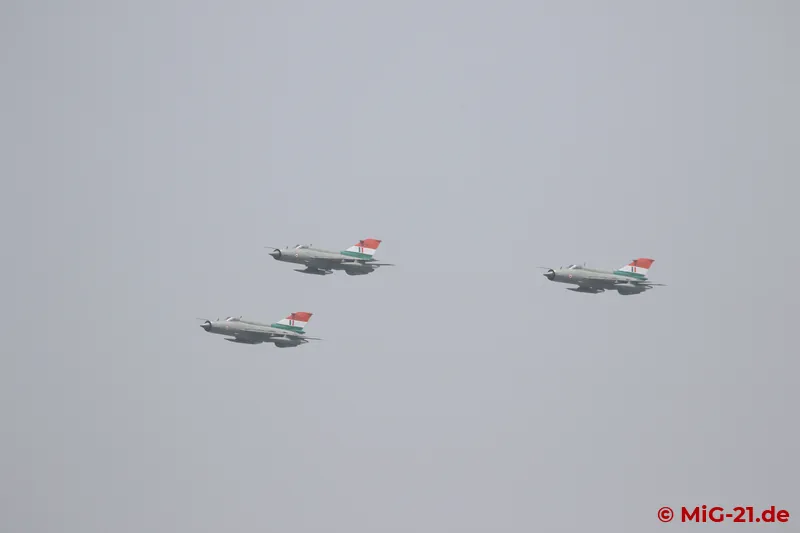
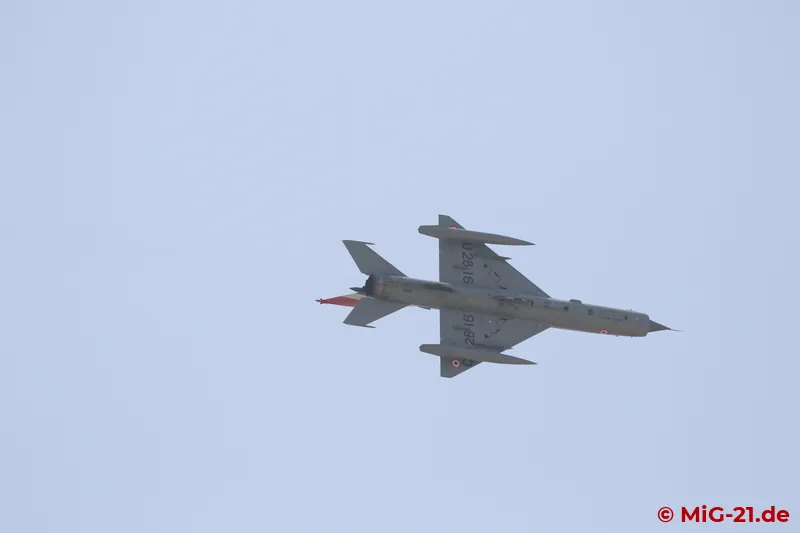
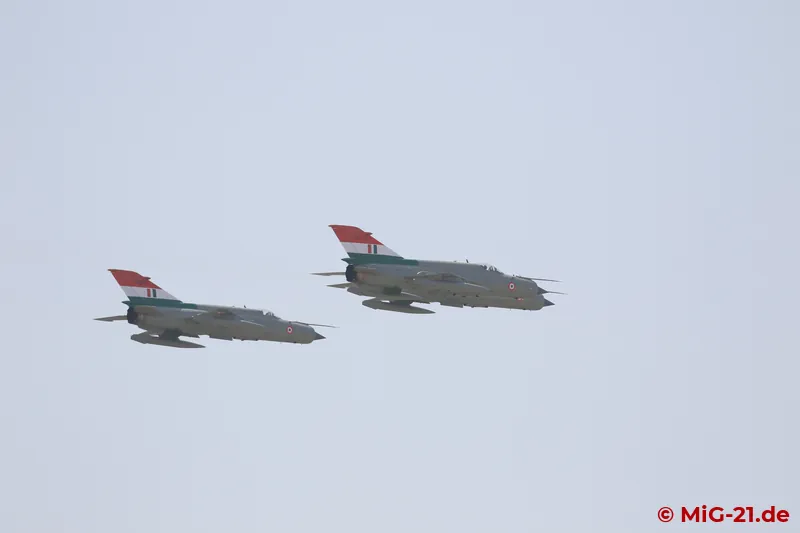
Then three MiGs come shooting in. Pulling the camera out of the rucksack and aiming is one and the same movement. I fire continuously, see one aircraft break away from the formation, but nothing more. I put the camera away again as quickly as possible and have no idea whether I have taken any decent pictures at all. Should I wait for another pass and risk being discovered after all? Two aircraft making a full turn and showing their upper sides answer the question. I aim once more, then pack up immediately and disappear. Nobody takes any notice of me, nobody calls after me.
What happens now I simply want to watch, and I return to the departures level. Airport employees and passengers have gathered there, attracted by the spectacle. I can hide among them and at least shoot a few phone videos. And the opportunity comes straight away: three MiG-21s, flanked by two Tejas and followed by the Surya Kiran aerobatic team trailing the Indian colours, approach over the runway. That would of course be a great photo motif, but safety comes first now. Like everyone else I pull out my phone and film the two Tejas climbing away while the MiGs and the Hawks of the aerobatic team pass over the runway. The MiG-21s then circle above us before coming in to land one after the other. I watch that too from my elevated position and keep toying with the idea of taking photos after all. But on the one hand there really is no unobserved spot, and on the other the results would not be worth the risk: the runway is far away and the ground shimmers in the heat.
Finally I watch the Surya Kiran display and, when it is over, set off back to the hotel satisfied. Once there, I immediately transfer my yield home – better safe than sorry – and am content and happy, as my minimum goal of seeing flying MiG-21s for the 32nd year in a row has been achieved.
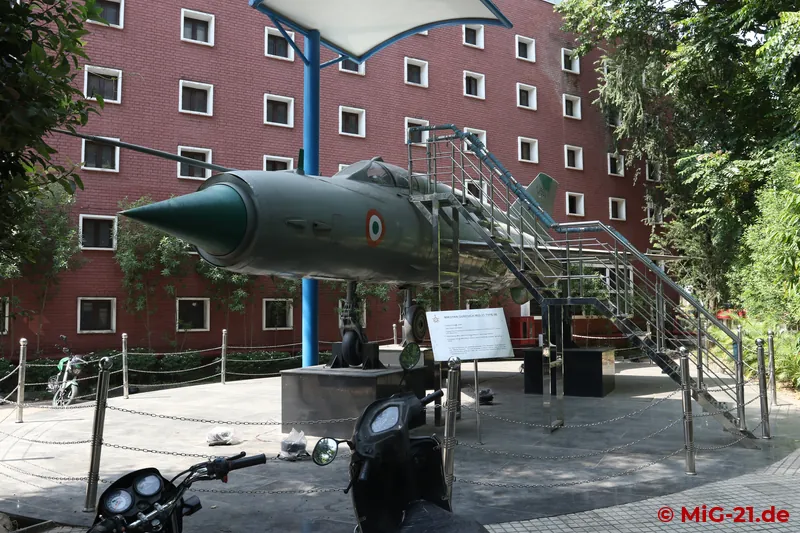
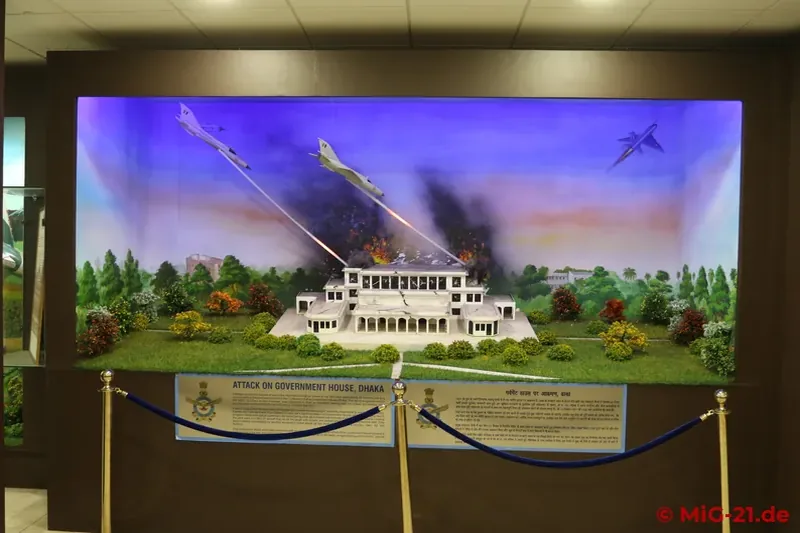
Thursday passes with a museum visit, a little shopping and sightseeing – as far as possible at 35°C – and then the big day has arrived.
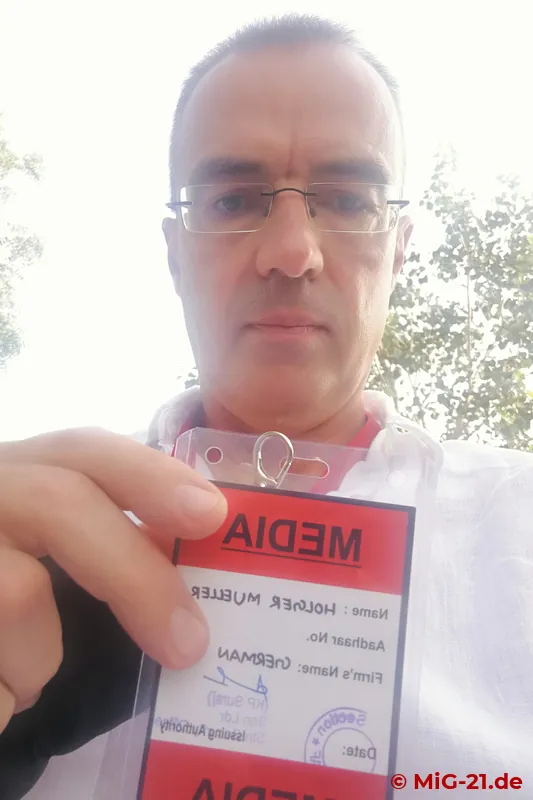
In his invitation e-mail (which reached me without problems), Wg Cdr Singh had included the coordinates of the press entrance. That, and the fact that I can enter these coordinates directly into the Uber app, spares me the endless palaver with taxi drivers who hardly speak English and do not really know their city either. Quickly and with plenty of time in reserve we head for the destination. In the last metres, however, another obstacle arises: one of the numerous guards posted every few metres to watch the road and check visitors thinks that I have to go somewhere completely different. My letter from the Defence Advisor in Berlin with many official stamps and emphatic demands on my part have an effect, though. A short time later we roll into a car park where two officers sit at a table with hundreds of badges in front of them. This is the right place. I pay my taxi driver, give my name and already have the press pass intended for me around my neck. That was easy!
I quickly get talking to the people around me, all Indian aviation enthusiasts and spotters who want to be there for the event and take home nice pictures. I am glad that the majority of the "media representatives" have interests similar to mine, as I had been worried that I might have to subordinate myself to the very different demands of the daily press.
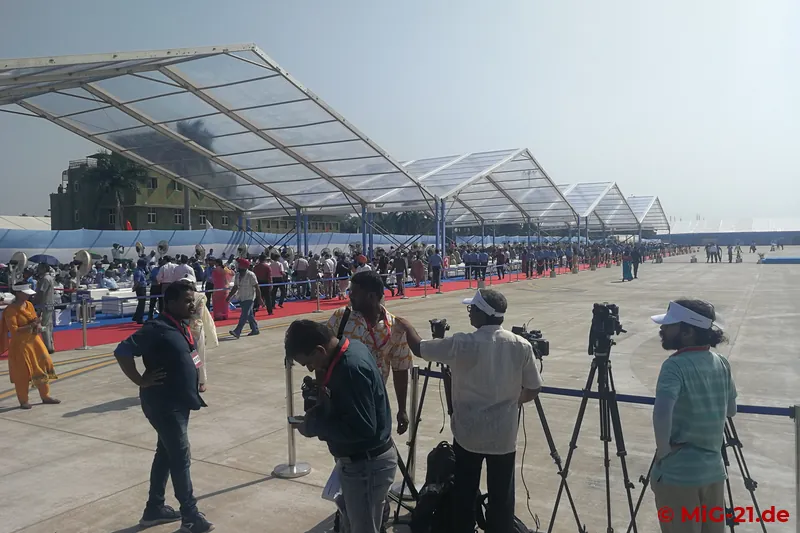
A short time later we board the pleasantly air-conditioned bus that takes us onto the base and to the venue. This is slow going, as large numbers of vehicles and pedestrians are on their way. At some point we are in and walk to large tents where buffets with sandwiches, pastries and drinks have been set up. I cannot eat anything, I am far too excited, but I have to drink, as it will be a long, hot day.
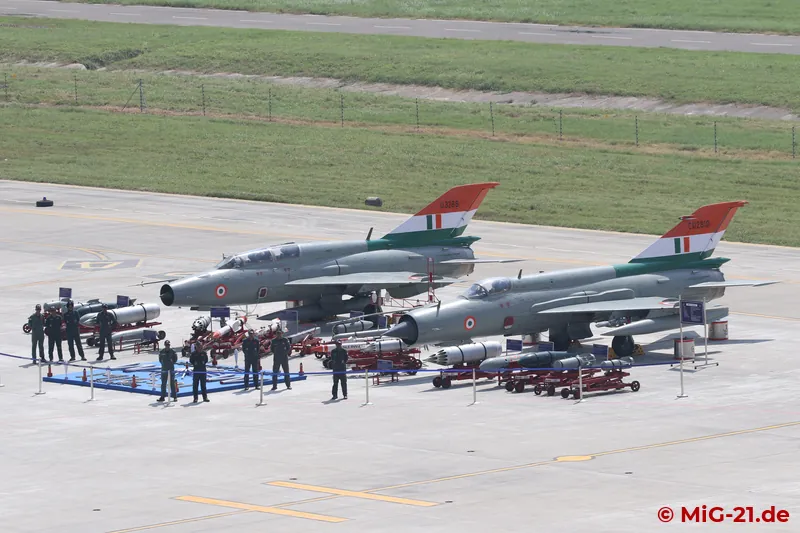
I stick with the Indian colleagues, because they know their way around and also know many of the military people walking around here. And when the first group sets off – wherever to – I go along. A short time later we are standing on a platform for the media, right in front of the covered grandstands for visitors and guests of honour. Not far away stand two MiG-21s – a UM and a Bison – with their complete range of weapons. Of course they are my first photo motif, unfortunately against the sun, but never mind – the main thing is that I am here. The "battle against backlight" will dominate the whole day and I will never find the right camera setting, but in the end it is the experience that counts.
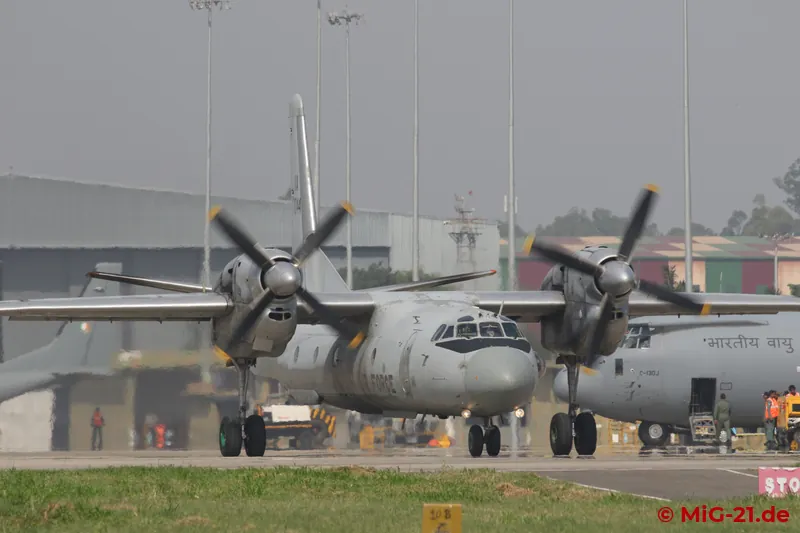
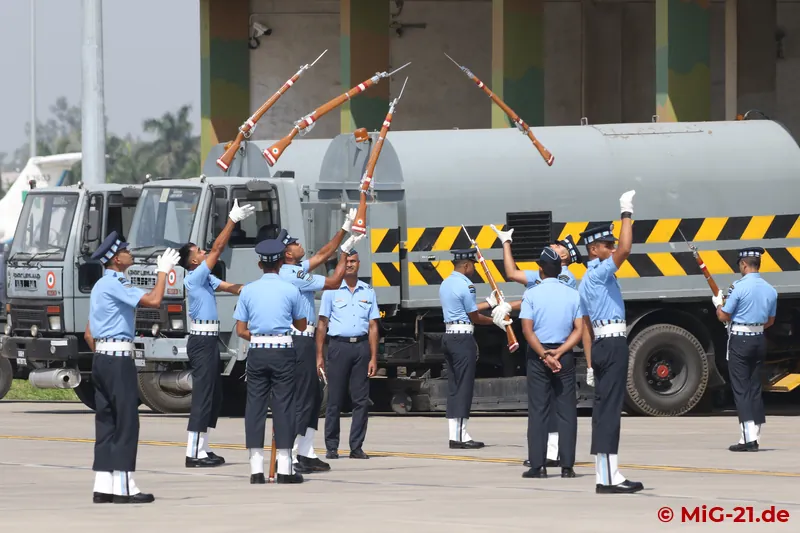
The wait until the programme starts at 11 a.m. can easily be bridged with photos of the busy flight operations. On the one hand, numerous air force aircraft land and take off – Embraer ERJ, C-130 Hercules, an Airbus, CASA C-295 – obviously dropping off guests. On the other hand there are also the local transport units with their Il-76, C-17 and An-32, one of the latter also taking off. Finally there are the soldiers of a ceremonial unit practising throwing their rifles – with fixed bayonets!
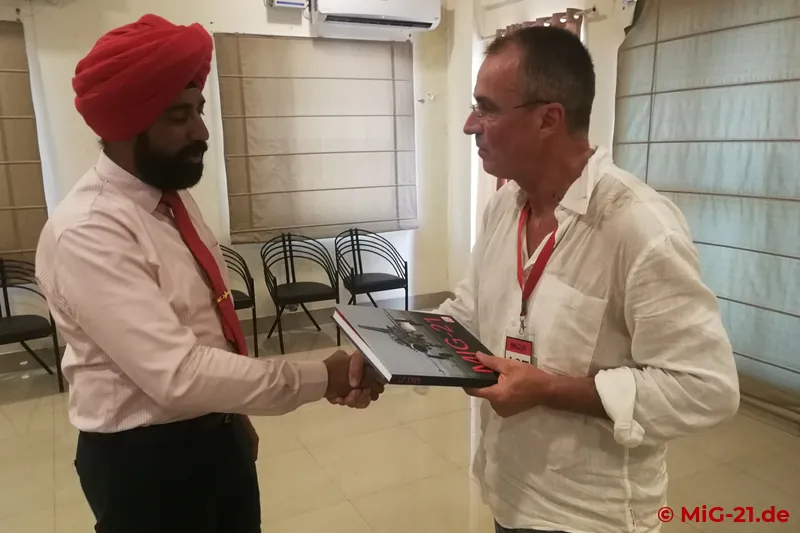
Then my phone rings. It is Wg Cdr Jaideep Singh, wanting to know where I am. When I explain that I am already on the airfield, at first he cannot believe it. Obviously the smooth organisation surprises him. In any case we arrange to meet at my current position, and a short time later I stand facing the Sikh with a bright red turban – he is wearing civilian clothes instead of uniform today – and can express my joy at being allowed to be here on this day. From him I learn that selected Indian photographers and the foreigners – besides me there are two Taiwanese on site – may take pictures from the roof of the tower. I am a little torn, because the tower offers a great overview but is also considerably further from the runway than the photographers' platform. In the end, however, I opt for this exclusive position. Before we make our way up, there is still time to watch the interviews the Indian press is conducting with MiG-21 veterans, such as Air Commodore (ret.) SS Tyagi, who can look back on a record-breaking 4306 flight hours and 6316 sorties in the MiG-21.
Up on the tower roof – without railings or barriers, which our hosts keep pointing out – there is a great overview. Besides the handful of photographers, the only others on the roof are a few officers of the tower crew and individual soldiers of a special forces unit, who greet us in a friendly way. How they can stand it in their obviously not very airy combat uniforms buttoned up to the top is a mystery to me. Dressed only in thin jeans and a linen shirt, I am already soaked with sweat.
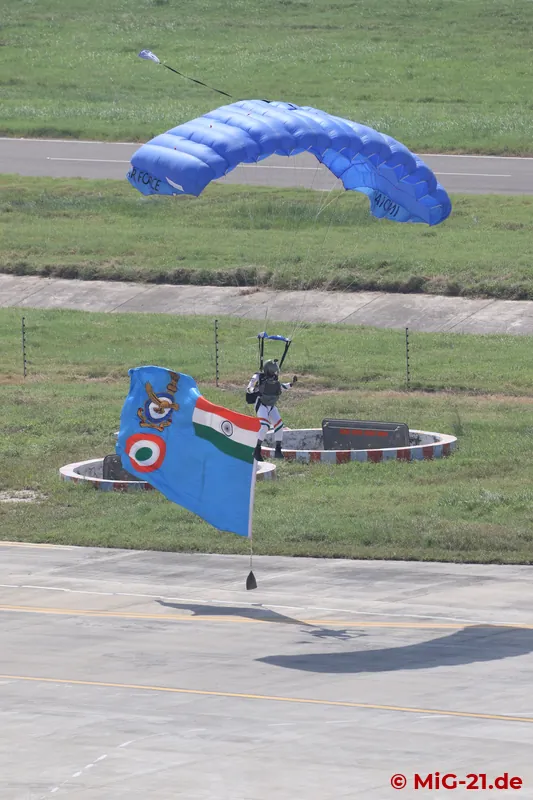
Then the time for the start of the programme arrives. Parachutists of the IAF parachute team "Akash Ganga" fall from the sky – literally, from my point of view, as I did not notice their drop aircraft, my gaze being fixed the whole time on the MiG-21s on the parking areas to the left and right of the runway. There is movement there now. Technicians run back and forth, and finally the aircraft taxi to the runway. Hardly have the parachutists landed in front of the grandstand when the first aircraft taxies out for take-off. The Chief of Air Staff (CAS) of the Indian Air Force, Air Chief Marshal Amar Preet Singh, insists on leading the flypast and takes off first. He is followed by six more aircraft in pairs. As always when MiG-21s are flying, I am excited and not every picture succeeds. But I take so many that there are sure to be a few good photos among them. The big problem is the backlight. Aperture up, aperture down – no setting really looks good in the preview.
The MiG-21s fly away, and on the area in front of the grandstands the ceremonial soldiers perform their spectacular drill show. The rifles fly and spin – impressive, especially considering that today's Bundeswehr can hardly manage to get a dozen rifles into line at its rare public appearances.
As the soldiers march off, the tension rises. Now the MiGs come from the east. I know the first formation: three aircraft, one of which, flown by the CAS, pulls away upwards. This time the aircraft are much closer than during the rehearsal, but the contrast against the sun and haze is also much lower. And already the solo aircraft is coming in to land. From above the contrast is a little greater, but the backlight prevents the fin in Indian colours from showing its full effect.
The Indian colleagues point out to me what comes next, which I had missed during the rehearsal because of my change of position. Two Jaguars "attack the airfield" and are intercepted by the MiGs. There they are already, and gone again. I see the MiGs only out of the corner of my eye (and only later discover on the photos that I had caught them on their approach).
The CAS's aircraft has come to a standstill between the transports west of us, and although the distance is quite large, the sun shines on the aircraft from the right side, which makes the picture look quite different.
Then the big farewell formation is already approaching: three MiG-21s, flanked by two LCA Tejas and followed by the nine BAe Hawks of Surya Kiran painting the Indian colours in the sky. The Tejas climb into the sky, the MiGs break formation, come in to land individually and taxi to the western end of the runway, where they wait. Enter Surya Kiran: the red and white Hawks stand out much better against the sky than the grey MiGs. And since they occasionally do not fly in full backlight during their manoeuvres, one or two nice motifs present themselves.
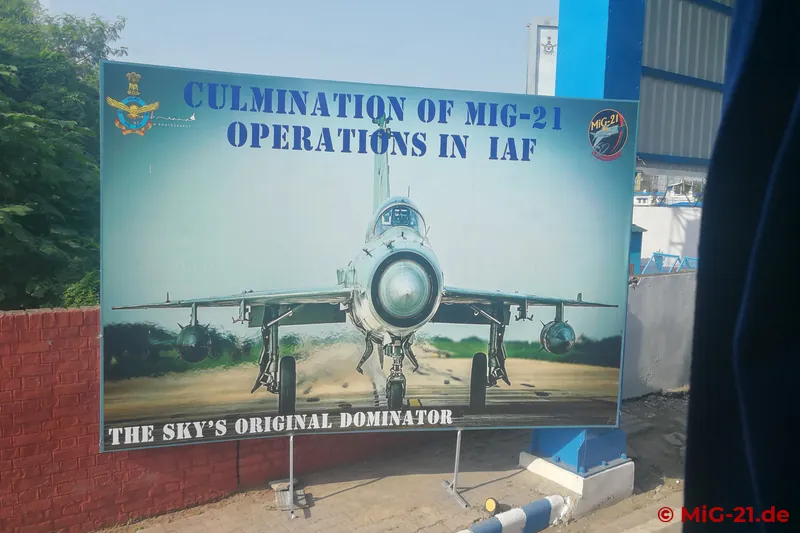
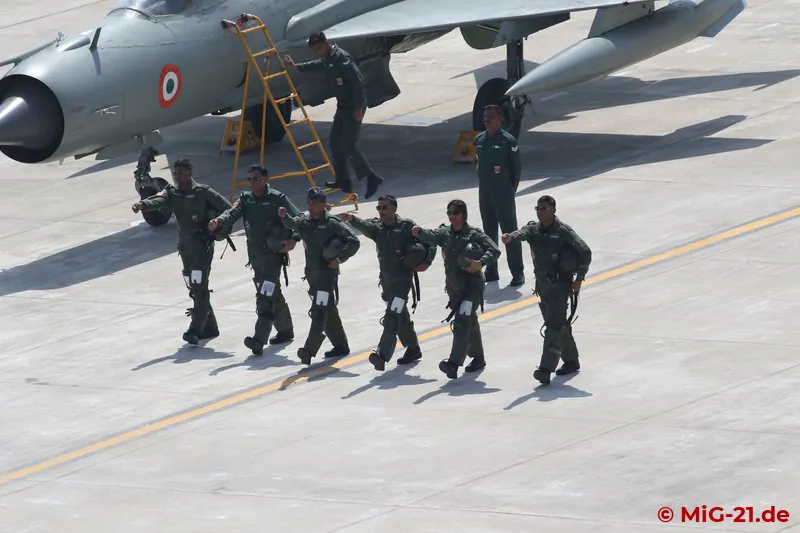
While the Hawks end their display with a heart in the sky to the delight of the spectators, two fire engines have taken up position at the stub taxiway in front of the grandstand. When the aerobatic team has disappeared, the MiGs begin to taxi in pairs along the runway towards the grandstand. In front of the grandstand they turn onto the stub taxiway and taxi under the water salute of the fire brigade right up in front of the spectators, where they form a semicircle. On command the engines are shut down, the pilots climb out and report to the Defence Minister and the CAS. With that, the 62-year service of the MiG-21 with the IAF is history.
We leave the tower roof and make our way to the parking area in front of the grandstands, which is now being flooded by spectators all heading for the MiG-21s. Pictures of the aircraft are unlikely to work out. But never mind, here too the experience is what counts. At least the two displayed aircraft with their weapons range are "protected" from the spectators by barrier tape and make a nice motif, as do the weapons lined up around them, including the lettering "MiG-21 – 1963 – 2025" laid out with shell cases and belt links. Countless former and current pilots, technicians and their families, official guests and visitors take the opportunity to have their picture taken with the IAF's best-known aircraft type. And so do I, of course. It is just a pity that the cockpits are off-limits and that it is hardly possible to photograph the aircraft from the flying programme without people in the foreground or background. But never mind – in return it is an extraordinarily atmospheric event.
Our escorts keep trying to drive us to the bus, announcing that lunch has been prepared for us in the officers' mess. But my Indian colleagues and I agree: who needs food when you can experience MiG-21s up close? At some point, however, everyone has their pictures in the can and can be persuaded to get on the bus. After a short drive we reach the officers' mess, and in view of the pans of fragrant food and plenty of drinks set out there, everyone realises how hungry and thirsty they were after all.
In exchange for our press passes, after the meal we receive a great farewell present: a bag filled with a wooden plaque on the Indian MiG-21 history, a bottle opener, a commemorative medal, a pin and a tie clip – all in MiG-21 design.
The bus takes us outside, a taxi takes me back to the hotel. For the flight home the next morning I have to get up early, in Delhi I have a layover of many hours, in Frankfurt we land late and baggage reclaim takes forever. But all that is completely irrelevant: I was there for the farewell to the Indian MiG-21s, and that memory remains.