 |
Dieter Flohr 120 pages, format 16.5 x 23.5 cm, approx. 250 illustrations, ISBN 978-3-86245-318-4 (in German) |
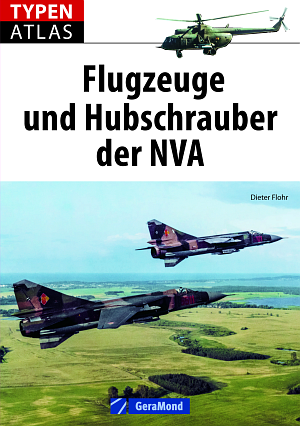
With the Typenatlas Flugzeuge und Hubschrauber der NVA, Dieter Flohr, who had so far appeared mainly with publications on the GDR People's Navy, deals for the first time with the Air Force / Air Defence (LSK / LV). The idea of offering an overview of the aircraft of this service is not new, as a glance at the bibliography shows. Even before the fall of the Wall, a two-volume work on the aircraft of the GDR armed forces was published, distinguished by an openness and detail unusual for the time. However, the book reviewed here is the first to offer this overview in one volume. A clear advantage is the clarity of the presentation, which for reasons of space alone is limited to the essential facts.
The book opens with a historical outline that correctly reproduces the main stages in the build-up of the armed forces in the GDR and dates the origin of the air force as VP-Luft to 1952. It is therefore incomprehensible why the back cover announces an overview of NVA aircraft and helicopters "from 1949 to 1989", especially as the book then correctly states that the NVA was only founded in 1956. Since it can be assumed that, more than a quarter of a century after the end of the GDR, younger readers or those interested in history but unfamiliar with the inner workings of the GDR will also read this book, a list of abbreviations would have been a desirable addition.
In the type section, one or two pages are devoted to each version of an aircraft or helicopter described, each with pictures, an explanatory text and a table of technical data. Particularly interesting are the chapters on aircraft that were also used by the People's Navy or in cooperation with it. There the author obviously contributes his own experiences and memories and thus also facts that were previously unknown to the reviewer. The large number of photos from the service period of the aircraft and helicopters is pleasing, although fewer but larger pictures would certainly have been more informative.
To assess the technical quality, the reviewer, who is by no means an expert on the history of the LSK / LV and has always limited his study of the subject to the MiG-21, concentrated on the sections of the book on this aircraft type. Numerous weaknesses become apparent. They begin with the second sentence on the subject, which claims that the first aircraft were used by JG-3 at Preschen. In fact, JG-8 at Marxwalde received the first MiG-21F-13s. And of course Chinese production of the MiG-21 – if this is relevant at all for a book on the NVA – did not end "around 1995", but in 2016.
It gets really "wild" with the next version, the MiG-21PF, which the author lists under its NVA designation MiG-21PFM. Only a few PFs are supposed to have been delivered and then "upgraded" to PFMs. And the distinguishing feature is supposed to be the pitot tube moved from the underside to the top of the fuselage. That is correct – but of course in comparison with the MiG-21F-13. Finally, the author goes so far as to claim that the radar proved useless and the aircraft were refitted with the RP-22 (of the MiG-21bis), which is simply nonsense. He has obviously also never realised that the official type designation MiG-21PFM belongs to the version designated SPS or SPS-K in the NVA, for there is no other explanation for two pictures of the later version appearing in the section on the MiG-21PF. Illustrating this chapter with a MiG-21PF bearing the West German national insignia (which the retired aircraft officially never received) rounds off the sad picture at this point.
Why a picture of a pilot in the cockpit of a Su-22 appears in the chapter on the MiG-21SPS/SPS-K (alias PFM) ("in return", the Su-22 chapter shows a MiG-21 described as a Su-22UM3K) remains the author's secret, as does the repetition of the picture of a landing MiG-21U shown two pages earlier. To the statement "The pilot now also had a radar sight screen on the instrument panel" one would like to reply: where does the author think the corresponding device of the MiG-21PF was located? The claim that applying camouflage paint meant "giving up the speed advantage of a polished skin [...]" amused the reviewer. And the statement that the short range of the MiG-21 was initially compensated for (the author does not reveal how it was later) by guidance from the ground provokes the question whether fighter control transmitted fuel as well as steering commands. The reviewer, who did his military service on the MiG-21bis, also wonders what "very special high-altitude pressure suits reminiscent of cosmonauts" the "pilots of this MiG generation" are supposed to have worn. And finally, anyone who has given even rudimentary thought to the economics of armament should realise that the airframe of the MiG-21bis, produced in more than 2,000 examples, does not consist "mostly of titanium". This list could be continued almost indefinitely and is the reason why the reviewer burst out laughing several times while reading the relevant chapters before head-shaking took over again. Incidentally, it should be noted here that the NVA did not have "Jagdgeschwader" but "Jagdfliegergeschwader".
It would also be interesting to know how the author arrives at the figure of 18,000 MiG-21s built. Given around 10,600 Soviet, almost 200 Czechoslovak and almost 500 Indian aircraft, almost 7,000 J / F-7s would then have had to be built in China, which is simply illusory.
In view of this desolate treatment of his "pet subject", the reviewer only skimmed the chapters on other types, but nevertheless came across all kinds of oddities. These include the unreflected statement that the LSK / LV had "little luck" with the MiG-19. The considerable losses with this type as well as with the first versions of the MiG-21 were mainly due to the young army being overtaxed by this then very modern and complex technology.
Linguistically, the book has numerous weaknesses: Mi-8TBs attacked "in packs" and a Su-22 "comes from landing". British journalists work for "Airforce Mounthly", which is not a typo, as the name appears twice. And of course the An-2 was not "the only aircraft type that remained in service until the end of the NVA [...]", but the only one that flew in its service from beginning to end.
Walter Lehweß-Litzmann was not a fighter pilot but a bomber pilot, and how the "Soviets" are supposed to have presented him with a posthumously awarded decoration (the German side thought he was dead) remains the author's secret.
And so on, and so on ...
These shortcomings are certainly not only the author's fault. The editing and the publisher's work in general reveal (to put it cautiously) weaknesses. This is already evident when the back cover speaks of Russian MIG instead of Soviet MiG fighters. The incorrect spelling with three capital letters can also be found in the text now and then. And if the author – correctly, in the reviewer's view – spells Antonov with a "w" in German, this should also be done on the cover.
The conclusion at the end of the book, which honours the achievements of the people who maintained and flew the aircraft and helicopters described and once again makes clear the conditions under which the LSK / LV of the NVA existed, closes the book on a conciliatory note, but cannot make up for the deficits of the good 100 pages before it. Anyone looking for a general overview of the equipment of the GDR air force who can do without a factually correct account in many places (or wants to, given the comparatively low price) may manage with this book. All other readers are referred to the other relevant works, of which even the 30-year-old first work is far better in quality.
 |
Stefan Büttner / Martin Kaule 240 pages, format 22.0 × 26.0 cm, 320 illustrations, ISBN 978-3-95462-784-4 (in German) |
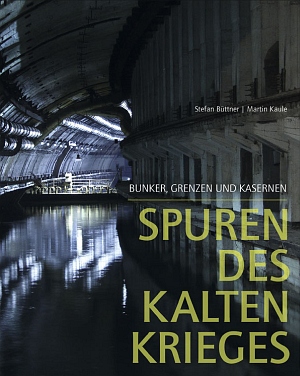
Traces of the Cold War? More than a quarter of a century after the fall of the Berlin Wall, the upheavals throughout Eastern Europe and finally the collapse of the Soviet Union, these should have largely disappeared – or so one would think. Far from it: since these traces are mostly cast in concrete and therefore do not disappear by themselves, there are still many of them. And they are often still visible because in many places it has since been recognised that these traces should be preserved as important contemporary witnesses and memorials.
The authors present more than 100 such traces. The fact that this is a deliberate selection makes it clear that the number of relics of this era is much greater than a book can hold. If one considers how much work by hundreds, thousands or even tens of thousands of people went into the individual sites, it becomes clear what an enormous waste of human and technical resources the decades-long confrontation between East and West entailed.
Reading the chapters on the shelters more closely, it becomes clear what enormous efforts were made on both sides in the case of the command bunkers to enable a small group of people to survive a nuclear war for at least a few weeks. But what would have happened to the survivors, who would at some point have had to leave their shelters to replenish the used-up resources? And what would have happened to the millions of soldiers and civilians for whom such bunkers existed only in part or not at all?
And if one then considers how many of the sites described served to store and deploy nuclear weapons with enormous destructive potential, it becomes clear how narrowly mankind escaped annihilation – intentional or accidental – during the Cold War. This should be understood as a warning not to allow such a confrontation between power blocs again – especially here in Europe, where the Cold War was coldest, left the most traces and, in view of the renewed exclusion of Russia, may be facing a new edition.
It should be particularly emphasised that, with "Spuren des Kalten Krieges", the two authors deliver an extensive work that, in times of "Google journalism", is essentially based on their own on-site research. The list of illustrations proves this, as do the many details contained in the individual site descriptions.
The authors would like the book – as can be read in the foreword – to be understood also as a travel guide that encourages readers to visit the places described. For the reviewer, this worked: some of the places described will be the destination of future trips. At the top of the list: the Chinese aviation museum Datangshan, listed in the book under the name of the nearby Shahezhen base. It is good that GPS coordinates are given for each entry, allowing unambiguous identification and navigation.
It is interesting to learn that numerous relevant sites in the successor states of the Soviet Union can now also be visited. About a seventh of the book is devoted to these sites in Russia, Ukraine, Kazakhstan, Estonia, Latvia and Lithuania, which are often still unknown in Germany.
Often the reader will be amazed to find that he has been very close to the places described, has driven past them and yet had no idea what was hidden there. In the case of the reviewer, this includes the Bay of Kotor in Montenegro, whose submarine tunnels remained hidden from him until he read the book. On the other hand, some readers will also be reminded of their own travels. This was the case for the reviewer with the GSFG headquarters at Wünsdorf, the aircraft tunnel at Gjadër in Albania and the Vranica site at Batajnica airfield in Serbia (for which the book, for inexplicable reasons, uses the spellings "Wraniza" and "Batajniza"). From the point of view of the MiG-21 enthusiast, the latter two are also among the particularly interesting places directly related to the subject. Others are the Chinese aviation museum already mentioned and the airfields at Finow and Marxwalde (today Neuhardenberg).
Understanding of the historical conditions under which each site was created is helped by contemporary historical essays preceding individual chapters. Readability would probably have been improved if these introductions had been arranged by country. This is particularly evident in the case of Iceland, where one paragraph on the site is preceded by two pages on the country.
It would have been desirable for the table of contents to include not only the countries mentioned but actually all sites. The index of places at the end, which lists the places practically as running text, is rather confusing.
The editing reveals weaknesses when the text at one point speaks of the Soviet "President" Joseph Stalin, while elsewhere his title as General Secretary of the CPSU is correctly given. Nor was it Croatia that was non-aligned at the time the Željava cavern was built, but the then Yugoslavia. These are not the only at least unfortunate formulations in the text, but they by no means diminish the value of the book – as a travel guide and contemporary historical treatise at the same time.
  |
Martin Janoušek 88 and 128 pages, numerous illustrations, format: 21.0 x 29.7 cm (in Czech) |
Anyone who has developed a passion for collecting on a subject has one thing above all in mind: the completeness of the collection. To achieve it, the collector sometimes has to take unusual paths when it comes to collectibles that are themselves unusual. For books on the MiG-21, which are the subject of the author's collection, this applies, for example, when they are not available in the book trade – not even internationally.
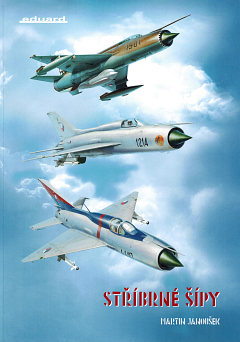
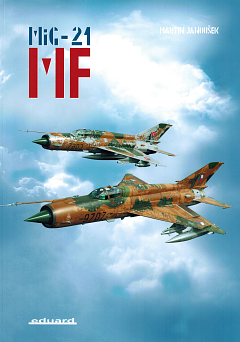
This is the case with the two books by Martin Janoušek on different versions of the MiG-21, as each is part of a high-quality (and correspondingly priced) model kit. Even if the author, who is not a modeller, cannot judge whether the kits live up to this standard, the books certainly do. Both the book on the Czechoslovak "Silver Arrows", i.e. the second- and – depending on one's view – third-generation MiG-21s delivered with a silver skin, and the one on the MiG-21MF (including the MiG-21M) in Czechoslovakia and in its successor states, the Czech Republic and Slovakia, would certainly be bestsellers even without the kit. Each book offers numerous historical photos, many of which were unknown to the author despite his long involvement with the subject. Many of them document "special incidents", i.e. crashes and accidents (with and without fatalities), which also occurred in service with the Czechoslovak Air Force. Equally interesting are the numerous photos and drawings of special paint schemes, which – unlike in the East German Air Force and the other Warsaw Pact air forces – obviously existed in the Czechoslovak PVOS throughout the MiG-21's service life.
Pleasing for those interested in history are the numerous accounts by those involved, including not only pilots but also technicians, the important part of the personnel that is often forgotten. The individual deliveries and their distribution to the regiments are documented in detail. The fact that the text of the books consists essentially of very extensive captions and only a few pure text passages sometimes makes it difficult to keep an overview, but on closer inspection constitutes the real value of the publications, as these captions provide valuable background information beyond explaining the picture content.
Particularly pleasing for readers with no or only limited knowledge of Czech is an English translation of the MiG-21MF book, available on the Eduard website.
It is to be hoped that these high-quality kit "supplements" will be followed by more.
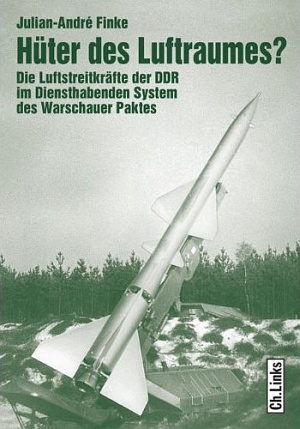 |
Julian-André Finke 408 pages, 19 illustrations, format: 14.8 x 21.0 cm, ISBN 978-3-86153-580-5 (in German) |
Hardly any work on the military history of the GDR has so far been commented on as excitedly as the book "Hüter des Luftraumes?" (Guardians of the Airspace?) published by the Militärgeschichtliches Forschungsamt. The waves ran high even before the book was in the shops. The biggest bone of contention was the fact that an officer of the Bundeswehr, who was moreover still a child when the GDR ceased to exist, had taken on the history of the Air Force / Air Defence (LSK / LV) of the NVA. This aspect in particular is of course absurd: if historians were required to be contemporary witnesses of the events they research, contemporary historiography would reach back no further than the Treaty of Versailles.
Although almost 20 years have passed since aircraft with GDR national insignia last took off, only a few notable contributions to the history of this service – by no means small, especially by today's standards – have appeared in the meantime. In 1992, Wilfried Kopenhagen's book "Die andere deutsche Luftwaffe" was the first overall account of the subject, even if the interval to the events was still too short to present all aspects of the air force in the eastern part of Germany in a balanced way. Nevertheless, the author, who died far too early, deserves credit for being the first to devote himself to the LSK / LV to this extent. How highly the achievement of the former NVA military journalist Kopenhagen is to be rated is shown by the fact that his work – under the title of the later edition "Die Luftstreitkräfte der NVA" – is quoted in numerous places by author Finke.
The main actors themselves – former officers of the LSK / LV – remained silent or limited themselves to treatises on details of their former work. Only in 2009 did former commanders present an account of the subject from their point of view with the book "Erlebtes und Geschaffenes". However, the work, written in the style of a chronicle from NVA times and which could have been published unchanged before reunification, lacks any critical self-reflection.
The book "Hüter des Luftraumes?", published in March 2010, does not, however, aim to be an overall account of the development of the LSK / LV, but examines the sovereignty of the GDR on the basis of air sovereignty. To anticipate the result: author Finke conclusively proves that the GDR's air sovereignty initially did not exist and at the end was still severely restricted, the growth in responsibility of the GDR military being due both to its increased capabilities and self-confidence and to the increasing economic weakening of the Soviet Union. The lack of sovereignty corresponds to the experience of every GDR citizen, even if members of the military who, like the reviewer, served in subordinate positions in the duty system had to feel, given the numerous alerts and the constant high readiness states, that the protection of the GDR's airspace rested solely on the shoulders of the LSK / LV.
In his research, the author relies mainly on documents of the LSK / LV themselves, available in the Federal Archives / Military Archives. Because of this and not least the wealth of material incorporated and quoted, a history of the LSK / LV has nevertheless emerged which – here the hastiness of the critics mentioned at the beginning becomes clear – largely presents the GDR air force's own view. The massive use of NVA sources is, however, also a problem – many of the author's conclusions based on the rather sparsely quoted Western sources thus lack legitimation by correspondingly detailed material from the other side. The general validity of some statements on the LSK / LV is also limited by the fact that only sources on selected units were considered, which is, however, quite legitimate given the objective. The work has minor weaknesses in statements on technology, which are moreover sometimes based on dubious sources.
Anyone who shies away from studying more than 300 pages of text to gain this insight is recommended to read the two concluding chapters. In the penultimate section, author Finke first works out that the Federal Republic, too, could not carry out air policing under national responsibility until the conclusion of the Two-plus-Four Treaty in 1990 because of Allied reserved rights, and that consequently not only the GDR was massively restricted in its sovereignty; at the same time he makes clear that the structures and mechanisms of the Warsaw Pact and NATO and the two German states' possibilities of influence within their alliances differed. Finally, in his concluding remarks, he stringently summarises the results of his research on a few pages, again highlighting absurdities such as the fact that the decision to destroy airspace violators rested solely with the Commander-in-Chief of the Group of Soviet Forces in Germany (GSFG), while the GDR had to bear international legal responsibility for these actions. The question implied by the title of the book – whether the LSK / LV were really "guardians" of their own airspace – the author answers positively with regard to the GDR's own contribution to the duty system, only to add immediately that the NVA air force was not master in its own house.
A book well worth reading that makes clear how much the GDR's sovereignty in political and military questions was restricted. It would be interesting to re-evaluate, from this point of view, the judgements on the actions of leading political and military representatives of the GDR, as made, for example, in the Wall shooting trials. But that is material for another book ...
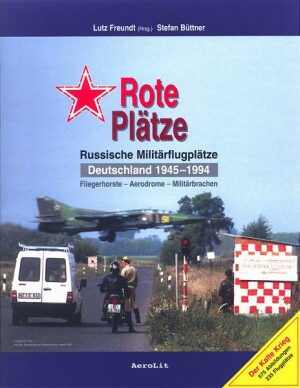 |
Lutz Freundt (ed.), Stefan Büttner 300 pages, 575 illustrations, including 110 aerial photos, format: 26 x 20 cm, |
The first truly comprehensive account of the Soviet / Russian military airfields in Germany not only sheds light on the stationing of flying units and their equipment, but above all deals intensively with the development, design and function of the infrastructure elements (flight operating areas, buildings and shelters).
Particularly noteworthy is the systematic approach with which the authors tackle the subject: beginning with the Soviet-occupied airfields in the former German eastern provinces, the airfield descriptions are arranged by region. The chapters on the sites in the Soviet zone, the GDR and the Federal Republic are preceded by a systematic description of the infrastructure elements, which makes the following chapters easier to understand. The uniform structure of all airfield descriptions into location, runway, history, infrastructure, operations (stationed units / aircraft types) and review, and the consistent(!) support of these aspects with facts, illustrate what an enormous amount of material the authors gathered in their research.
The work fully lives up to the high standard the authors set themselves in the foreword, also and especially in contrast to today's hobby and mass-media historiography.