(Text and photos: author)
Câmpia Turzii, March 2023
I had definitely imagined the end of this part of my involvement with the MiG-21 differently; after all, my relationship with the Romanian Air Force and its MiG-21s had been a special one. I travelled to Romania more often than to most other MiG-21 operator countries – 23 times in all. On these trips I found good friends and warm hosts. In addition, I encountered Romanian MiG-21s several times in Germany, at various events and exercises in Poland, Hungary, Serbia, France, Bulgaria, Great Britain and Austria and, not least, in 2007 during Baltic Air Policing in Lithuania (the list of events up to 2021 can be found in the article on the 60th anniversary of the MiG-21 in the Romanian Air Force). When in spring 2022 the decision was taken that the MiG-21 LanceR would only remain in service until May 2023, I applied again for permission to visit both remaining bases and was successful. While the visit to Câmpia Turzii could still pick up on "old times", the scandal during the trip to Feteşti already cast the shadows that were to culminate in the events at Câmpia Turzii in March 2023.
The good news first: for the 30th year in a row I saw flying MiG-21s. But only saw them. I was prevented from taking pictures by eight police officers / military police / secret service people(?) who were standing around me at the time.
But from the beginning: on Monday, March 13, I had a business appointment in Hungary, and as I assumed that the MiG-21s at Câmpia Turzii would be flying that week and the weather was supposed to be suitable at least on Tuesday, I decided on an excursion to Romania. As the only answer to my earlier request for permission to visit Câmpia Turzii had been that I would be notified when the farewell ceremony would take place, it was clear that there would be no opportunity to visit before then.
Late on Monday evening, after a trouble-free drive, I arrive at my hotel in Turda, and after a night with little sleep (I find it increasingly difficult to sleep reasonably after long drives) I drive the next morning from Turda to Călărași-Gară on the east side of the base. I park my car in the middle of the village, unload my folding bicycle and first ride to both ends of the airfield to look for a photo position. I wear a high-visibility vest while doing so. Later I took it off, which was probably a mistake, as will be seen.
Construction work is currently going on along the entire east side, and the Romanians had already been extremely sensitive about photos of infrastructure on my last visit, so really only spots at the north and south ends of the runway remain. To make matters worse, there is a southerly wind that day, which might lead to a change of flying direction (approaches are usually made from the south). On the north side, the road from Câmpia Turzii to Călărași-Gară winds around the airfield. On an area at the edge of this road surveying work is in progress, so I would not be alone. In addition, an An-26 is just taking off towards the south, so the MiGs will probably fly in this direction too (although on my last visit MiGs and a C-130 took off in opposite directions). So back to the village. Flying was supposed to start at 1 p.m., but already at around 12.30 an afterburner thunders and obviously an aircraft is taking off towards the north. So I grab my bicycle, ride along a dirt track to a meadow at the southern end of the airfield level with the approach lights, sit down at the foot of a small hill there and wait for things to come.
At this point the weather is worse than forecast but shows clear signs of improvement. I use the An-26, again taking off to the south, and two helicopters flying north for test shots.
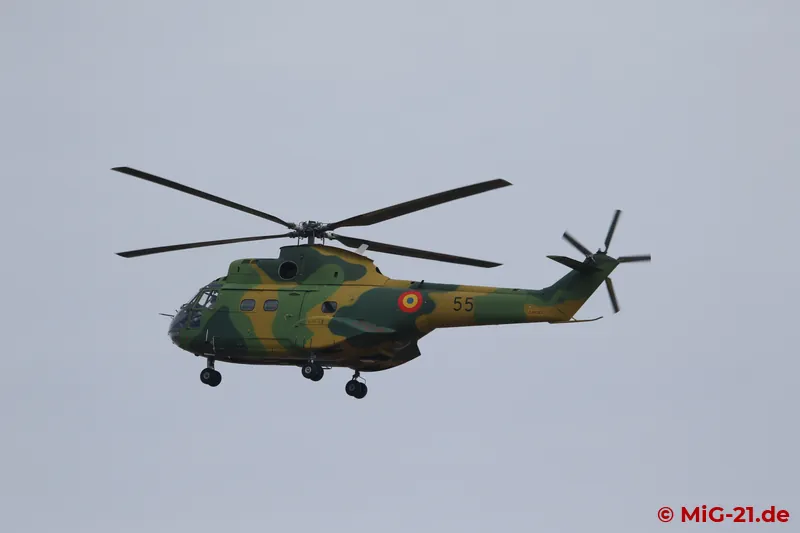
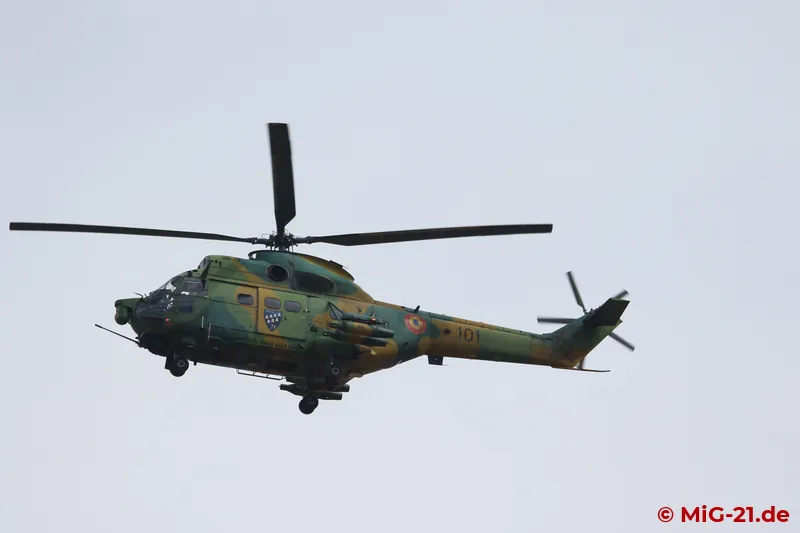
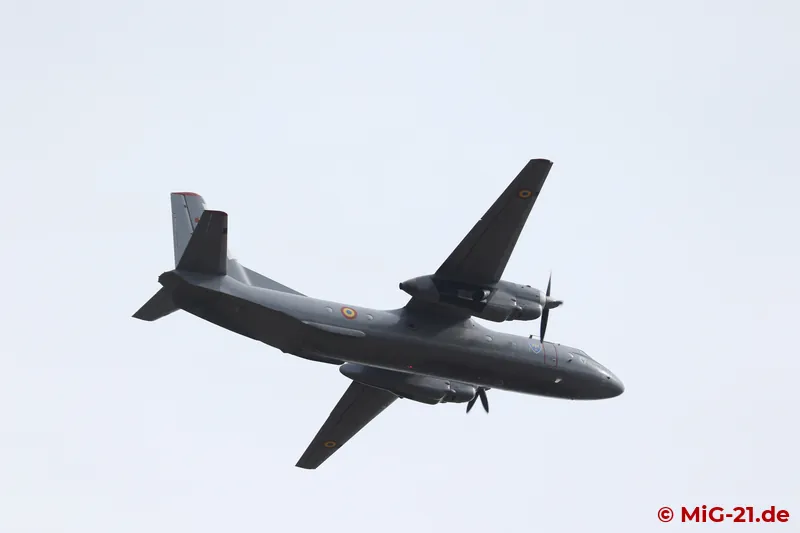
Then the wait for the MiG-21 begins. A short time later a military police Dacia drives along the road around the runway towards the gate on the west side, and a few minutes later I see it coming towards me along the dirt track. As its "visit" is obviously meant for me, I walk towards it. Immediately after the military police car comes a civilian Dacia. A uniformed man and a civilian get out of the first car, two civilians out of the second. I can no longer remember the exact discussion that followed. In any case, I explained that I was photographing aircraft here, of course only in the air and not the base. At the same time, two of the plain-clothes men begin searching my previous position and ask me whether I have companions, which I truthfully deny. At some point they also want to see my equipment, and I show them my pictures too. They explain that they will hand me over to the police, who will then take me to Turda for further investigation.
In the meantime the sun has come out. The MiG-21 that had taken off to the north earlier lands towards the south, so I do not see it in the air at all, but then a two-seater and two single-seaters take off towards the south and at least I can watch (had I dared to take a few pictures now, there would at least be a few MiG photos of the action, but at least I had seen the MiGs). We are still there when the two single-seaters come back, fly over the runway as a pair and then land individually.
At some point one and then another police car arrive, and bit by bit I explain to all of the now 8 (!) people standing around why I am there, that I have been here many times, why I am only interested in the MiG-21, and so on. This changes nothing about the situation, and nobody shows any sign of accepting that I had no bad intentions. After an hour and a half the word is: we go to the car and drive to Turda. I push my bicycle, flanked by police on the left and right, followed by four cars and watched curiously by the residents.
I open my car and it is briefly searched. In the car I have two of my books, which I show to my guards, which obviously does not change their view of what I was doing. Then I drive to Turda with two police officers on board, a police car in front of and behind me, and at least one of the other cars in tow. I have to park my car in the yard of the police station and am then led into the building. I have my photo equipment with me. The way leads past the detention cells in the basement, which do not look very inviting. I am first told to take a seat in the corridor outside some offices. After some palaver I am instructed to empty my pockets, and everything I have on me is recorded and photographed. When I say everything, I mean everything: every banknote, every card, even the bakery loyalty stamps in my wallet and the lens cleaning cloths in my trouser pocket are meticulously noted and photographed front and back. The man doing it is obviously from forensics, wears gloves and places one or even two measuring tapes next to each item. The whole thing takes about two hours, and I calculate that it might still be possible to photograph one or two aircraft in the last evening light. At that point I had no idea how wrong I would be ...
The confiscated items also include my mobile phone, from which even the SIM card is removed and photographed and documented separately. So I can no longer notify anyone.
After everything has been documented, it is packed into envelopes, bags and sacks, labelled and sealed. Then I am told that "officers from Cluj better trained for this purpose" (what purpose was unclear) would take over the matter. After some time two civilians appear, one of them visibly armed. As their origin is unclear, I demand that they identify themselves, and one shows me an ID of the special police unit for combating organised crime and terrorism! The other colleague is said to be a forensic specialist. He promptly begins to open and search the packages that had just been sealed. Then I realise that the whole thing will not be over so quickly, and I demand to be allowed to call my family and / or the embassy. The answer is: when the investigation is complete and the prosecutor has agreed. That should not take very long, though. But it does; time passes and by now it is dark. To my question of how things will proceed, the answer is: we are waiting for the search warrant for my hotel room. At some point it arrives (it is already about 8 p.m.), and as we leave the building for the car, I again demand a call home and refuse to leave the building until then. I am threatened with being forcibly put into the car, but at the same time promised that I could make a call at the hotel after my lawyer (! – provided by the state) and an interpreter had arrived.
At the hotel the massive police presence frightens the reception staff, who are then immediately asked to be present as witnesses during the search. So at first four police officers and I sit in my hotel room while hotel staff and more police wait in the corridor until, after about another hour, the interpreter and defence lawyer finally arrive. Both first familiarise themselves with the documents. To my renewed question about a phone call home, I am told that in cases of "offences against national security" (probably the first time the word "espionage" is mentioned here) this could be refused and that this would be done here. According to the lawyer, that is correct. I slowly begin to "lose it". I know that my wife will be worried (she has not heard from me since the morning) and that the fact that my phone is switched off will certainly not help to reassure her.
Then the search of the room begins, and I hope that nobody before me has left anything incriminating behind. My notebook (which I did not have with me at the airfield and which therefore cannot contain anything forbidden) is confiscated, as is my backup drive. Both contain data from my work as well as my collected pictures! After each search, whether of personal items, room, then car and technical devices, a minute protocol – often handwritten – is drawn up, which I am asked to sign, which I refuse every time because I cannot read the Romanian wording.
At some point the search is over and I am told to pack my luggage, as I would not be coming back here. By then I feel pretty queasy. As we leave the hotel, I tell the employee that I will be in touch about the bill. Euros and credit cards have been confiscated, and the little Romanian money I was given back so that I could buy something to eat if necessary is not enough. So I cannot pay.
We go back to the police station and my car is searched there – much less thoroughly than the hotel room. Only the SD cards from the navigation system and radio are confiscated. It is now 10 p.m. or later. I am cold, I am shivering and I just want to get away. I am told to leave my luggage in the car. Only the packed and labelled "evidence" is taken along.
In the car of the police officers from Cluj, which had already taken me to the hotel (most of the way with blue lights and siren), we now go to Cluj. As the driver (the forensic specialist) had already raced through Turda like a maniac, I categorically demand a working seat belt (there had been none so far), and after some palaver the belts are pulled out from behind and the buckles from under the rear seat. On the drive to Cluj I try to sleep a little – hopeless given the rough driving style. In any case we arrive in Cluj very quickly and turn into a barred courtyard in a side street – we have arrived at the Directorate for Investigating Organised Crime and Terrorism! Remember the abbreviation D.I.I.C.O.T.
The duty officer sits in a narrow corridor and we sit on the chairs next to him. The TV is on and there is a report on the "shooting down" of an American drone by Russian Su-27s – that much I can gather from the Romanian subtitles. A connection with what is happening to me does not occur to me. After 12 hours in the hands of these people I am probably just too exhausted. The police officers accompanying me and also the two civilians from the very beginning, who never introduced themselves, disappear into a room and only come out again after some time. I hear that the prosecutor has ordered my detention for another 8 (!) hours. Interpreter and lawyer explain to me that I will shortly be questioned by the prosecutor. I should only answer questions if it does not incriminate me, but at the same time question everything myself. I have the right to do so.
It is shortly after 1 a.m. when we – interpreter, lawyer and I – are led into the prosecutor's office. Like all Romanian offices I saw that day, it is ugly, impersonal, bare. The prosecutor is in his mid to late thirties, unkempt, with a stained pullover, and does not seem very confident – not a good starting position. He presents the accusations – espionage! – and then I am asked to respond. I reject the accusations, explain my hobby in no uncertain terms, refer to my book, magazine articles and website. I also stress again and again that I never photographed the base because I knew how sensitive it was.
Then begins a question-and-answer game that lasts about 2 hours. The prosecutor asks a question in Romanian, the interpreter translates into English, I answer, the interpreter translates into Romanian and the prosecutor types with at most four fingers. Fortunately the interpreter makes sure that my exact words are reproduced and can remember longer passages well.
First I am asked to briefly describe my background – vocational training, military service, studies, work, hobby.
I can only remember some of the questions:
Why did I approach the base by bicycle and not by car? Because I fear for my relatively new car on the dirt tracks.
Why do I have a bicycle with me? I always have it with me when travelling; that is why it is a folding bicycle.
Why had I hidden in the meadow? I had not. I simply sat down so as not to have to stand for hours while waiting for the aircraft.
Had I done military service? Yes, in the GDR, as an aircraft technician, which is why I have this hobby.
Had I worked or was I still working for intelligence services? No.
What was my attitude towards the EU and NATO? Irrelevant.
What was my attitude towards Ukraine and Russia? Irrelevant. I have been to both countries, to Russia 20 years ago.
Did I speak Russian? Not really.
Where in the world had I been for aviation? I listed the European and Asian countries and did not forget to mention that the Chinese entry stamps in my passport, which the investigators had looked at with such interest, came from a completely public and online-documented trip to North Korea.
How did I finance these trips? By earning well (I have to give a figure too).
Did anyone pay me for information or give me instructions on what to look at? What I look at no longer interests anyone and nobody would spend money on it, except perhaps the 30 euros for my book.
Why had I come to Romania again although my last request for a visit had been refused? It had not been refused; I had merely been told that I would be invited to the MiG-21 farewell in due course. As the MiG-21s would only be flying for two more months and I happened to be nearby – in Hungary – I took the opportunity.
Whom did I know in the Romanian Air Force? I list some of the high-ranking contacts and mention only in summary my contacts with dozens of pilots, technicians, press officers ...
I protest once more that I was not allowed to call home or the embassy. I would be allowed to in due course. When would that be? After the investigation was complete. This discussion took place, in this form or a similar one, probably a dozen times during my odyssey through Romanian law enforcement.
The questioning ends at about 3.30 a.m. I have not slept for about 20 hours, have eaten nothing (I was not hungry, even though I was offered something in between) and have drunk little. It was still not to be over, because now my technical devices and storage media would be examined. Interpreter, lawyer and I go down to the basement, where there are a number of desks with computers, servers and large storage systems. A younger civilian begins to take my devices out of the bags and examine them. Interpreter and lawyer look over his shoulder. An armed plain-clothes police officer is asleep at another desk. I can't go on, can't contribute anything either, and follow his example.
I wake up again at about 7.30 a.m. The technician is not finished yet. The notebook (and thus the most critical device) is still outstanding. As nobody is paying attention to me, I finally manage to contact my wife using my lawyer's phone: "I'm fine. Will be in touch later." My wife, sick with worry, writes back: "So relieved, I was about to go to the police". Reply: "That's where I am, unfortunately the Romanian police". At least now I no longer have to worry about my wife's fears. Then the examination of the devices is finished too. Interpreter and lawyer tell me that the report says "nothing found". And then right away the next bad news. The devices have not been released; they are packed up again and laboriously (as again and again over the last hours) labelled by hand and sealed. The prosecutor from the night is no longer in the building, his colleague now responsible is not there yet, and she has to release the devices. When will she come? Nobody knows.
We go outside. It is cold and I am shivering. Still, nice not to be "locked up" and closely watched any more. I had already got back my passport, ID card and car key during the night, together with my Romanian money. Wallet, credit cards, phone – everything I need for the journey home – are still in the hands of the authorities. I take the opportunity to call the German embassy in Bucharest. During the night this would not even have been possible, as the emergency phone is not staffed between midnight and – if I remember correctly – 7.30 a.m. After all, no emergencies happen at that time ... I reach the embassy, describe my situation, am passed on several times and finally end up with a Romanian lawyer working for the embassy, who tells me that the embassy may not intervene in ongoing proceedings, but could at least notify my relatives. Fortunately I had already been able to do that myself. Imagine the shock if the German embassy called from the country where the missing person happens to be. At least I leave my details with the embassy and receive the assurance that they will keep an eye on the matter. While I am on the phone, the news comes: the devices have been released. I had already been thinking about leaving the country without them, but this is of course much better. Back in the basement the sealed packages are torn open, and I have to confirm receipt and completeness (which I largely do not care about, having got the most important things back).
I exchange contact details with the interpreter and lawyer. The latter, son of a former air force and now civil pilot, receives a copy of my book as a thank-you for his support during the night. I promise the interpreter to send him one from home. Both go on to their next cases, although they have slept even less than I have during the night. I say goodbye and thank them warmly.
With the plain-clothes police officer who had slept in the basement, I wait outside the building for the final OK, and then he drives me back to my car, which is still at the police station in Turda. On the drive we talk about family, work – all very civil and friendly. In general, most of the time things had been civil and friendly – it was still not nice.
Arriving in Turda, my companion quickly arranges the release of the car, I say goodbye, throw the rucksack with notebook and cameras into the passenger footwell and drive off. I am so tired that I will certainly not manage the distance in one go, but I want to get out of Romania. On the way I have to refuel and buy something to eat. After about three hours of driving I am at the motorway border crossing near Arad. After five or ten minutes of waiting it is my turn. A quick look at my ID, no further check, and I can go. The tension falls away from me, the storm shakes my car, rain drums on the roof and I know that I cannot drive much further now. At the next, largely empty rest area I stop, recline the seat and am asleep after a few minutes. Somewhat refreshed, but still dead tired, I drive on. I refuel once more in Austria, sleep again once in Germany, and at exactly midnight, after 1500 kilometres and almost 12 hours, I am back home – and sure that I will never go to Romania again.
Bacău, May 2023
However, the resolution only lasts a few weeks and crumbles with every day the announced end date of May 15 draws closer. In addition, the press office of the Romanian Air Force had announced that I would be notified of a farewell event in due course. In view of the recent events, however, I have my doubts whether that would still apply. Rightly so, as it turns out.
From contacts in Romania I know that the farewell date is fixed and that events are planned for the occasion at Câmpia Turzii, Feteşti and Bacău, where the MiGs are to be ferried. Two weeks before the date my patience runs out and I ask the press office by e-mail for information on the date. Answer: none. At the same time I hear from various sides that the Romanian Air Force promises information on the event at the latest a week before the date. So there is still hope.
May 8, the day on which information on the event had been promised, passes without my receiving any news from Bucharest or anywhere else. On the morning of May 9 I contact my previous contact person in Bucharest via WhatsApp. Answer: none.
When, on the evening of May 9, the events at Câmpia Turzii, Feteşti and Bacău for Monday, May 15 are finally announced on the Romanian Air Force website and press representatives are invited to register, I do not hesitate for a moment and send requests both for Câmpia Turzii, with which I have the most memories, and for Bacău, where the very last act is to take place (and where, as an "emergency option", there will also be a public event). Answers: none.
Never mind. As I now assume for sure, given the lack of an answer from Câmpia Turzii, that I am not welcome there, I am by now firmly determined to go to Bacău. In view of the public event, but also because it is an airport close to the city with mixed military and civil use, I reckon that my best chances of becoming an eyewitness in some form, in any case and without great risk, lie there. And I plan to drive there by car, so as not to be stranded at a Romanian airport if I am turned away at the border. Besides, the drive across the country is a nice opportunity to say goodbye to the country I have travelled more than any other outside Germany.
Even though I am now sure that the public event is my only chance, I want certainty. On the Friday before the date I contact the press officer at Bacău. Nobody answers the phone, so I try WhatsApp. Indeed, a good hour later an answer comes: I should send my request to the base (which I had already done) and to the address of the press office in Bucharest (which is certainly not a good omen). I do as I am told, and an hour later the expected answer comes: "We are sorry, the accreditation has not been confirmed". So it is clear: the only option is to attend the event as a perfectly normal visitor, and I will do everything not to reveal my identity.
As I am apparently still persona non grata in Romania, I ask my Romanian court-appointed lawyer from March whether I should expect problems when entering the country again. Answer: none.
On Saturday, May 13, I set off from Thuringia in the morning, aiming to cross the Romanian border the same day and thus at least have certainty on the question of whether I am allowed in or not. In the late afternoon, I am already deep in Hungary, I receive a message from the press office at Câmpia Turzii. "Your accreditation has been refused because of the incident in March." That is the first time anyone has spoken plainly! It goes on, verbatim: "as the procedures regarding photography and access to the base were not observed, participation in this event is not possible. Have a nice evening!". I certainly did not have one. In any case, it is now clear that there is no alternative to Bacău. With anxious anticipation I roll towards the border. After a few minutes it is my turn, a quick look at my ID and I am in Romania. So far, so good.
I stop briefly, book a hotel in Arad (where I had never been before), take a short walk through the town there and then sleep reasonably well. The next morning I continue to Bacău. As far as Sibiu I drive relaxed on the motorway. Then it continues on country roads. A good five hours for about 300 kilometres, the satnav announces, and memories of wild races on Romanian roads 20 years ago come back. But it is Sunday, and in Romania, too, mostly Sunday drivers are on the road that day. The drive drags on, and only the beautiful landscape makes up for the dawdling.
At around 5 p.m. local time I roll into Bacău. And there a MiG-21 monument greets me, which I had seen in pictures but never in reality. So I stop and take a few photos – not only for documentation, but because on the last trips to Croatia it had proved a good omen to visit a "plinth MiG" before the actual event ☺.
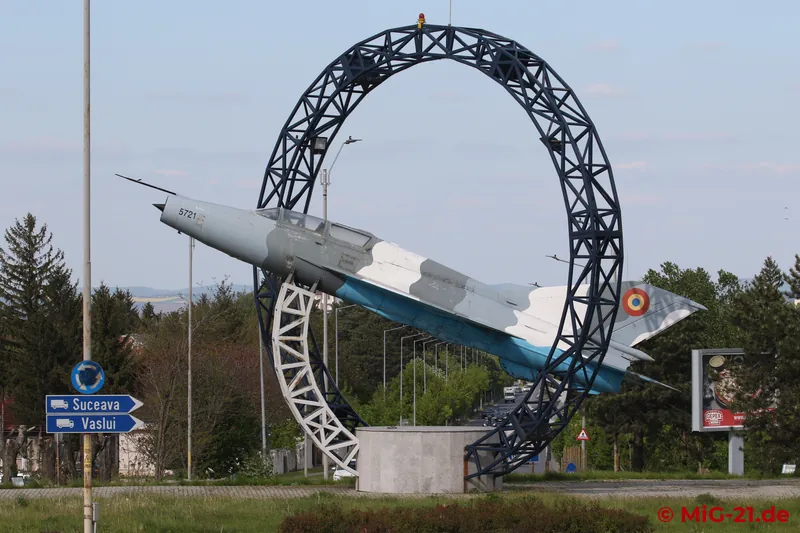
Before driving to the hotel I go looking for possible photo positions outside the airfield, because I in no way trust that I will actually be let in the next day. I also look for a parking spot near the entrance to the base, but far enough away not to get stuck in the arrival traffic if I am turned away and to reach an alternative position in time.
I am not entirely satisfied with my reconnaissance, but after a strenuous drive I decide to postpone further exploration to the next day. I check into the hotel and then take a walk through the town centre. Finally I discover an open-air restaurant in the town park and let the evening end in a relaxed way.
Then the day of decision has come. After a short and restless night I set off for further reconnaissance. Beforehand I had asked my Romanian contacts when the MiG-21s were supposed to land. 12.52 p.m. is the answer from Câmpia Turzii, 1 p.m. the one from Feteşti. Not much time, then, for an alternative if I were refused entry to the base at 12 noon. A strong southerly wind at least spares me looking for alternatives for both approach directions. On satellite images I had spotted a cemetery on the west side of the airfield, which I now drive to. While the cemetery itself does not prove to be the right place (among other things there is a military radar site next to it), on the way there I find an elevated spot with a good view of the entire airport area.
After this discovery I set off for the base. The address of the base given on the internet is a few hundred metres away from the signposted entrance. Because there is also a gate at the supposed entrance, it is unclear where entry will actually take place, and I spend some time looking for a parking spot for my car from which both places can be reached quickly on foot. Finally I find one on an undeveloped plot where other cars are also parked. There is still plenty of time until entry, and I stroll to both gates without being able to tell where the real entrance is. I go back to the car, wait some time and repeat the exercise. Now, just under an hour before opening, many people are gathering in front of the main entrance to the base. So this is the entrance. I take the opportunity to take a few phone pictures of the MiG-21 monument at the entrance to the base, right next to a small church.
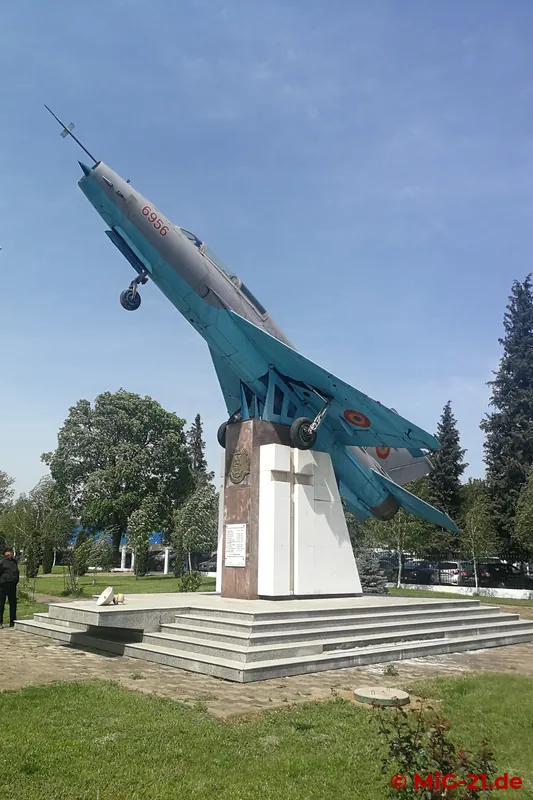
Those gathering at the entrance are mostly older and know each other – obviously veterans either of the air force or of AEROSTAR, where MiG-21s have been overhauled since 1968. Cars with high-ranking officers roll up. Press representatives and spotters who – unlike me – have been admitted to the event are registered and receive their passes. I see only one familiar face – Viorel Bilu, the former company pilot who had test-flown the Mozambican MiG-21 during my last visit to AEROSTAR in 2013.
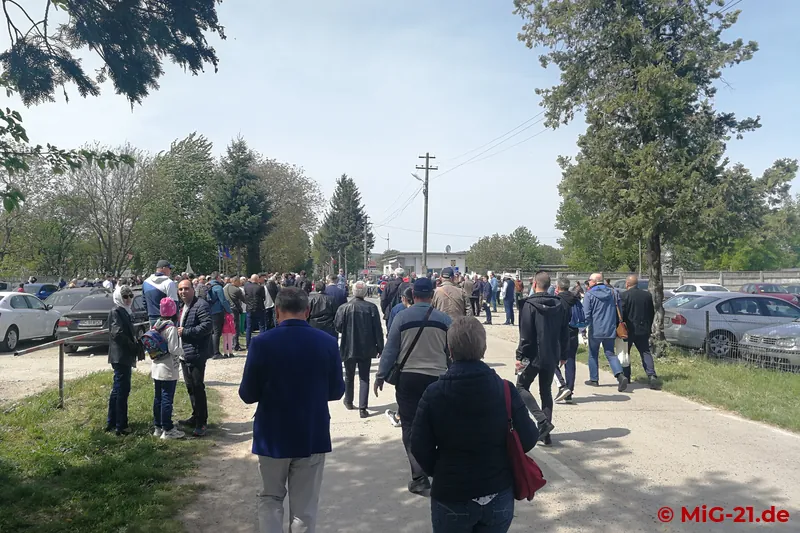
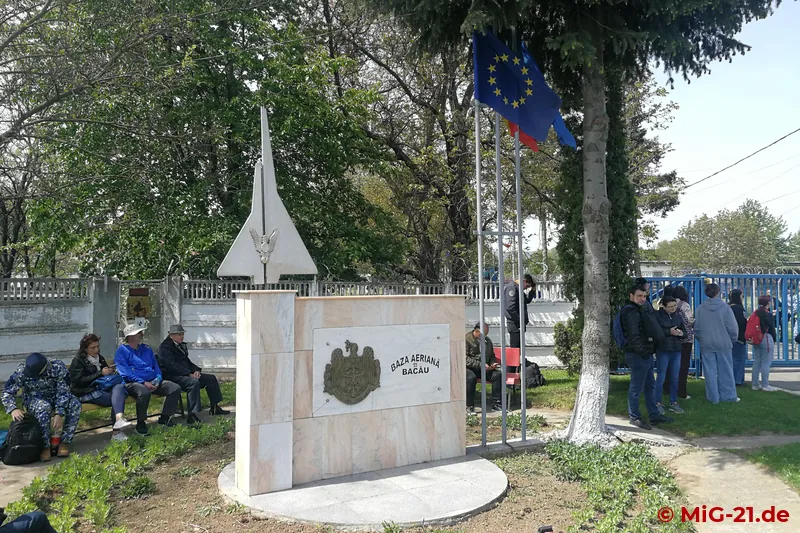
Shortly before 12 noon the crowd starts to move and the "normal" visitors stream towards the entrance. However, the barrier does not open; instead everyone has to pass individually through a narrow entrance where their ID is checked. Not a good sign! Next to me in the queue is a young man with Asian features. I let him go first to see what happens. He is not let through by the gate guard and is referred to a colleague at the guardhouse. The same happens to me and to an Italian who comes after me. We are told that foreigners are not admitted. I refer to the English-language announcement on the air force website, according to which all aviation enthusiasts are welcome. This is a Romanian base and only Romanians are allowed in here, we are told. Disappointment spreads, only somewhat relativised by the fact that I am not the only one affected.
Now plan B has to work. I quickly make my way back, past the visitors still arriving, the young man from Asia beside me. In conversation something incredible comes to light: my companion, a South Korean student of international politics studying in Moscow (!), was arrested at the beginning of this year, just like me, while taking photos near the base at Câmpia Turzii. Like me, he was taken first to Turda and then to Cluj and interrogated. But that is where the similarities end. He was taken to Bucharest in handcuffs, first locked up in prison there and, even after his release, not allowed to leave the country for two months. So I had been really lucky with my 23 hours of enforced stay. I admire his courage to come back again after this experience. But he absolutely wants to see the Romanian MiG-21s.
As he has come by public transport, I offer him to come with me to my alternative position. Together we drive to the hill on the west side of the airfield and take up a position at the edge of a field above the road. Now it is time to wait. While we exchange experiences, we keep glancing anxiously at the road. No police in sight so far, but again and again cars that stop and occupants who look at us curiously. Then someone comes towards us – fortunately with a camera and lens. It is a spotter from Bacău who came too late to get to the base in time given the crowds of visitors and therefore drove to the other side. He assures us that there is no danger from the police. We are not convinced and keep looking around anxiously.
The announced arrival time has long passed and unease grows. The wind is also picking up more and more, while haze slowly moves in front of the sun. I am freezing cold. At last three of the familiar silhouettes appear on the horizon, approaching quickly. They fly into the frame, continuous shooting, and then the camera fails with an error! I actually thought the fault had been fixed. Off, on. Hopefully the camera will hold out. In the viewfinder I had seen that the first aircraft were those from Câmpia Turzii. Already the next three are approaching, this time from Feteşti. Like their predecessors, they fly over the airfield and break formation. Then all six aircraft come in to land individually. I try to stay on them until touchdown. Again and again the camera cuts out. Switch cameras and back again. Nevertheless: as my photo report from Bacău shows, I should end up with at least one picture of each aircraft.
And was that it? We remain undecided at our position, and indeed – after some time three more aircraft take off. Three helicopters circle, one of them with a flag, and two light aircraft are also over the airfield. Will the MiGs come again? Another Romanian joins us. The registration of his car ends in MIG21, and in conversation it turns out that he is a former MiG-21 and IAR 99 pilot. From him we learn what could not be seen from the great distance: the aircraft that took off are IAR 99s. The MiGs have landed and will not fly again.
We pack our things, walk quickly to the car and leave. I drop my companion at the railway station and set off on the way back. Now just get out of Romania. This time I choose the northern route via Piatra Neamț, not shorter but much less busy and, thanks to three mountain crossings, great fun to drive. A nice side effect of the route: I pass Câmpia Turzii once more, where at the MiG-21 memorial for the pilots killed in crashes I remember my friend Laurenţiu KIRU Chiriţă and finally say goodbye to the Romanian MiG-21s.
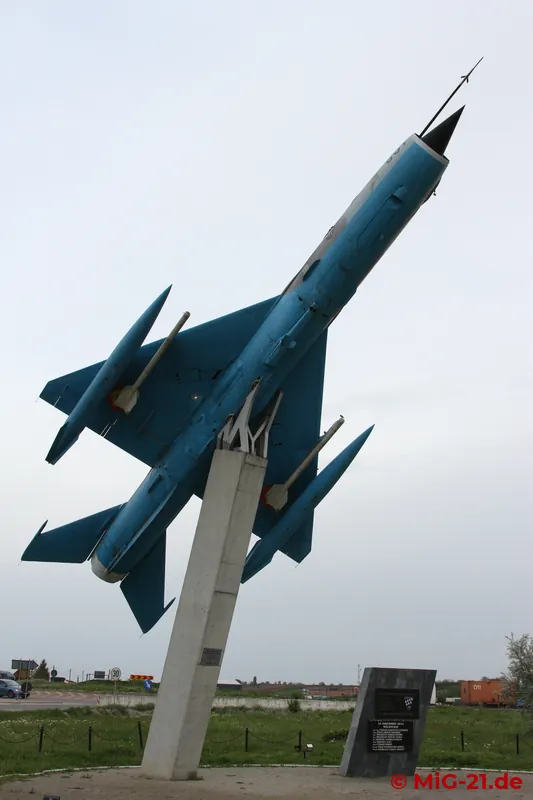

About three hours later I am at the Nădlac border crossing. Another two hours later I am still there. The sluggish progress of the checks once more raises the worry whether everything will go smoothly on leaving. But on the Romanian side the look at my ID takes only a few seconds. It is the Hungarians who take so much time. Never mind, I am out. Shortly before midnight I check into the hotel in Szeged and fall into a deathlike sleep. After a hearty Hungarian breakfast and a real fright at the next petrol station, because the nozzle will not go into the filler neck (only the third nozzle is accepted by my car), I drive for nine hours, mostly through pouring rain, to arrive home in the evening exhausted but satisfied. Despite all adversities – I am glad that I was there for the farewell to the Romanian MiG-21s.