|
Notice: This page is not subject to any update. For updated information please refer to the German pages of this website
or the publications by the author.
About 20 main and sub versions of the MiG-21 can be divided into four generations. In the following the main features of
the several generations are shown.
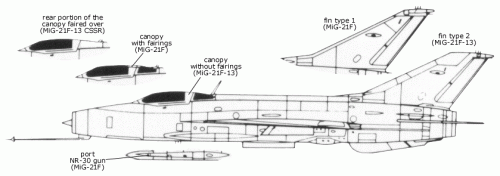
Daylight interceptor without radar, armed with guns (one or two 30mm NR-30 respectively), guided or unguided missiles
on two wing pylons.
- MiG-21F (Изделие = product 65)
- MiG-21F (72)
- MiG-21F-13 (74)
- MiG-21F-13 (S-106, built under licence in Czechoslovakia)
|
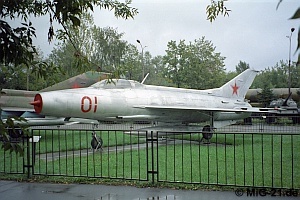
First production model:
MiG-21F at Central Army Museum Moscow.
|
|
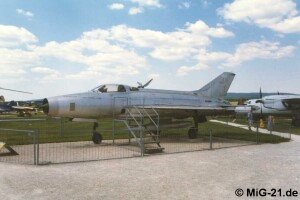
The MiG-21F-13 was built in large numbers for both Soviet Air Force and export. The aircraft in Hermeskeil Museum
(Germany) was the first delivered to Poland and the second exported at all.
|
|
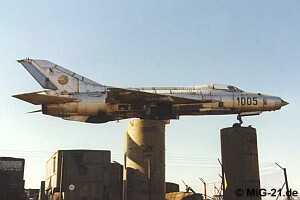
Recognizable by its metal-covered rear cockpit section
MiG-21F-13 from Czechoslovak production (seen here at a scrap yard near Hradec Králové).
|
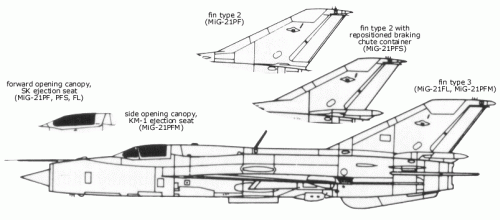
Radar equipped all-weather interceptor, armed with missiles on two wing pylons only, some versions with external GP-9
gun pod (one 23mm two-barrel gun GSh-23).
- MiG-21PF (76)
- MiG-21FL (77)
- MiG-21PFS (94)
- MiG-21PFM (94A)
- MiG-21PFM (94N)
|
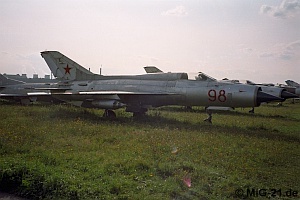
MiG-21PF at Moscow-Chodynka airport.
|
|
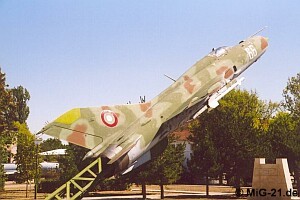
With new ejection seat KM-1 and side opening canopy:
Bulgarian MiG-21PFM as gate guard at Graf Ignatievo.
|
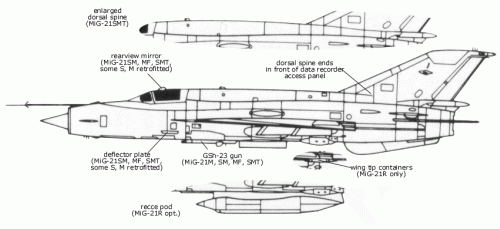
All-weather interceptor and reconnaissance aircraft with gun and missile (on four wing pylons) armament (one 23mm gun
GSh-23, MiG-21S with GP-9 gun pod, MiG-21R with recce pod instead of the gun).
- MiG-21R (94R, 03)
- MiG-21RF (94R)
- MiG-21S (95)
- MiG-21SM (15)
- MiG-21M (96)
- MiG-21MF (96A)
- MiG-21MT (96B)
- MiG-21MF (96F)
- MiG-21MF-75 (63)
- MiG-21SMT (50)
- MiG-21SMT (50bis)
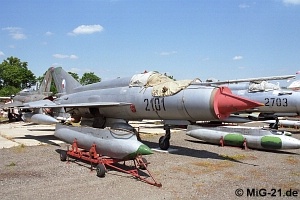
|
First model fitted with four pylons: reconnaissance version MiG-21R.
|
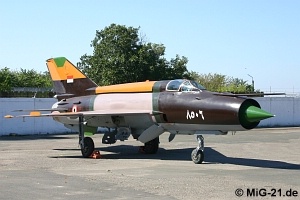
|
Reconnaissance aircraft tailored to Egyptian needs:
MiG-21RF.
|
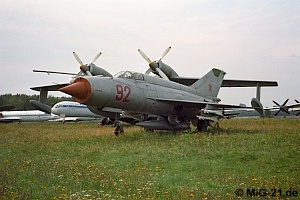
|
On display at Monino:
MiG-21S prototype carrying R-60 missiles on P-62-II twin launcher.
|
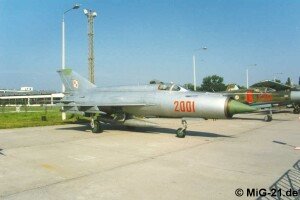
|
Purpose build for export:
Polish Air Force MiG-21M at Bydgoszcz Airshow 1996.
|
|
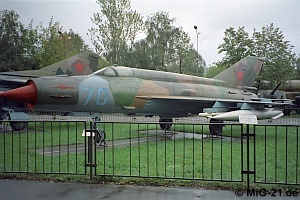
Exclusively in Soviet Air Force inventory: MiG-21SM at Central Army Museum Moscow.
|
|
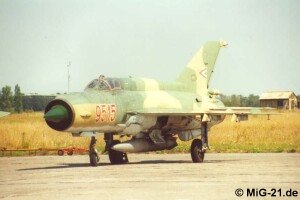
For export the SM model was equipped with the old RP-21 radar:
MiG-21MF of Hungarian Air Force in storage at Pápa in 2000.
|
|
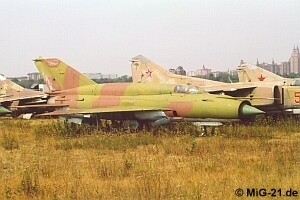
Too much: Because of its oversized spine the MiG-21SMT was difficult to fly. After the retirement of all Russian MiG-21
the SMT only can be found in museums - seen here at Moscow-Chodynka.
|
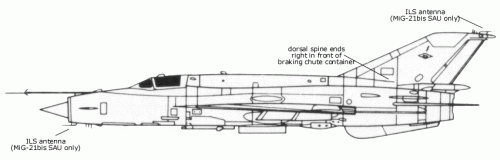
All-weather interceptor with improved air combat performances at low and medium altitudes, engine and airframe completely
redesigned.
- MiG-21bis LAZUR (75A*)
- MiG-21bis SAU (75B*)
|
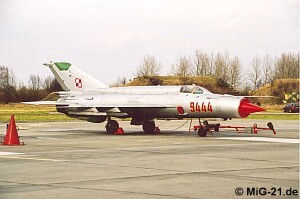
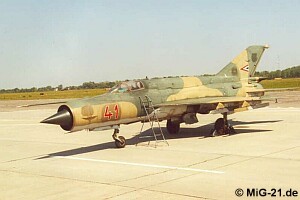
MiG-21's fourth generation is represented by the two versions of the MiG-21bis:
Polish MiG-21bis LAZUR at Malbork and ...
|
|
... MiG-21bis SAU of the Hungarian Air Force, stored at Pápa.
|
First, second and third generation of MiG-21 included a twin-seated trainer version. All trainers had two wing pylons
only and lacked internal gun and radar.
- MiG-21U-400 (66)
- MiG-21U-600 (66)
- MiG-21US (68)
- MiG-21UM (69)
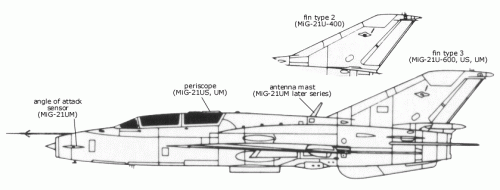

|
The first generation of MiG-21 trainers was delivered in two versions:
MiG-21U-400 and ...
|
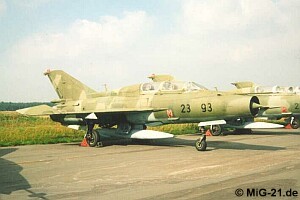
|
... MiG-21U-600 of the East German Air Force stored for scrapping at Rothenburg air base in 1994.
|
|
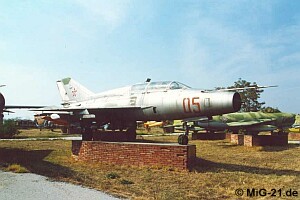
The new ejection seat required a periscope for the instructor:
MiG-21US at Bulgarian Air Force Museum Plovdiv in 2000.
|
|
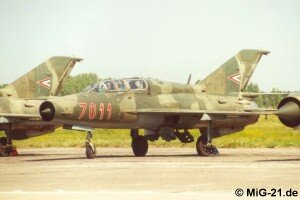
Trainer of the third (and fourth) generation:
Hungarian Air Force MiG-21UM stored at Pápa.
|
* unofficial designations
| Versions of the J-7 / F-7 |
|---|
The Chinese MiG-21 copies J-7 (home market) / F-7 (export) can be divided in three
generations based on the MiG-21F-13 airframe, a separate development featuring the fuselage of the MiG-21MF as well as a
number of twin-seated trainers. Today these types differ in many features from their Soviet predecessors:
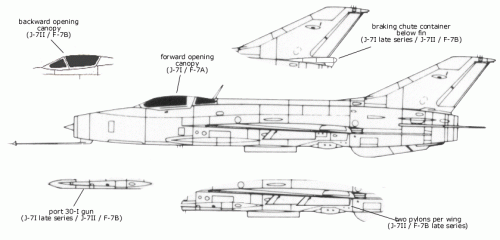
Daylight interceptor without radar or with radar range finder, armed with guns (one or two 30mm 30-I respectively),
bombs, guided or unguided missiles on two or four wing pylons.
- J-7
- J-7I
- F-7A
- J-7II
- F-7B
- F-7BS
|
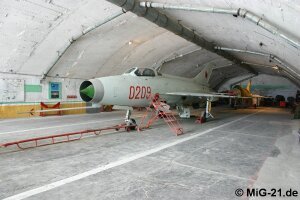
Like its ancestor MiG-21F-13 the F-7A is lacking port gun.
|
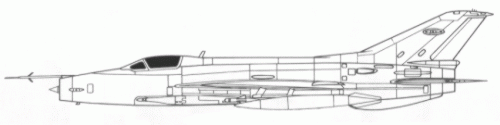
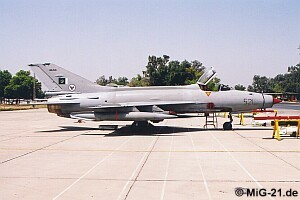
All-weather interceptor with radar, armed with guns (two 30mm 30-I), bombs, guided or unguided missiles on four wing
pylons.
|
The F-7P equipped with Western avionics is probably the most powerful version of the second J / F-7 generation.
|
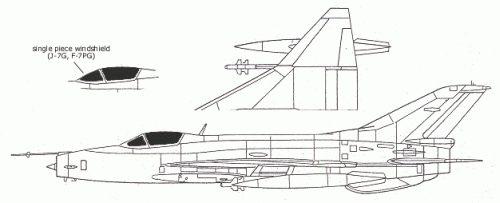
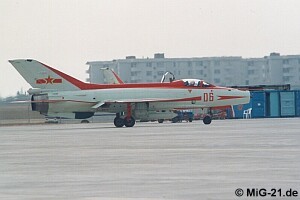
All-weather interceptor with upgraded avionics and double-delta wing, armed with guns (one 30mm 30-I), bombs, guided or
unguided missiles on four wing pylons.
|
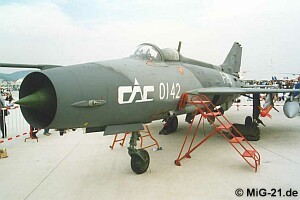
The J-7E shown here in the colours of the 1st August Team is the version for domestic needs ...
|
|
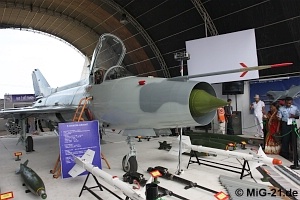
... while the F-7MG is produced for export.
|
|
Final version F-7G, in this case F-7GS for Sri Lanka.
|
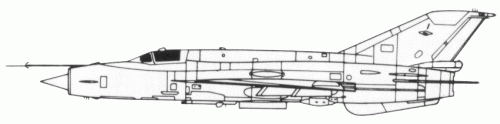
All-weather interceptor with an airframe similar to the third MiG-21 generation, armed with guns (one 23mm-cannon),
bombs, guided or unguided missiles on four wing pylons.
- J-7C / J-7III
- J-7D / J-7IIIA
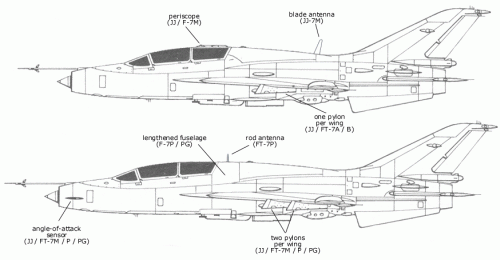
Several variants of twin-seated trainers, some armed with guns (one 23mm-cannon), bombs, guided or unguided missiles on
two or four wing pylons, with and without radar.
- JJ-7
- FT-7
- JJ-7A
- FT-7A
- JJ-7B
- FT-7B
- JJ-7M
- FT-7M
- FT-7P
- FT-7PG
- FT-7NI
|
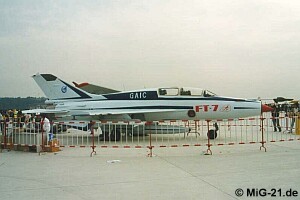
This FT-7 shown at Zhuhai in 1998 is one of the earlier versions recognizable by its two pylons.
|
|
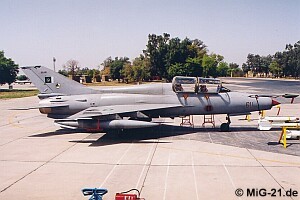
FT-7P with four pylons and ventral 23mm cannon.
|
|
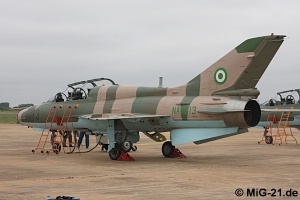
Featuring avionics of J / F-7G: FT-7NI.
|

|